Why a VC Will Take a Lighter to Your NDA
Non-disclosure agreements (NDAs) can be important legal documents for the startup entrepreneur. If drafted carefully, the NDA can protect your confidential idea from being highjacked by employees and other parties. (Well, the NDA won’t actually stop the disclosure of confidential information, but it will make for a nice “EXHIBIT A” in your lawsuit against the leak.) Just don’t make the rookie mistake of asking a VC to sign your NDA.
Asking a VC to sign a NDA is tantamount to splitting 10′s at the blackjack table. You just don’t do it. In the least, it will show that you do not understand the mechanics of how VCs operate. At worst, the VC will burn your NDA and dump your submission in the trash.
If VCs maintained the practice of signing NDAs for each submission they received, only two groups would benefit: lawyers and paper companies. Lawyers would benefit because they would get to draft, edit, and negotiate each NDA. Additionally, the VCs would have to retain a team of lawyers to keep track of all the NDAs they’ve signed with the fund-seeking entrepreneurs that have come before you. Therefore, NDAs would increase a VC’s transaction costs and potentially prevent a VC from even hearing your pitch. Both reduce the already slim chances you will get funding.
So what do you do if you have “the next greatest thing” that no one else can know about? Don’t tell anybody about it. Or at least be careful and selective of what you reveal. You may not have to disclose the entire schematic to pique the interest of a VC. And if you do get some interest, a VC may be a little more willing to sign your NDA at that point. Finally, remember that “first to market” doesn’t always make you the winner.
About the Author
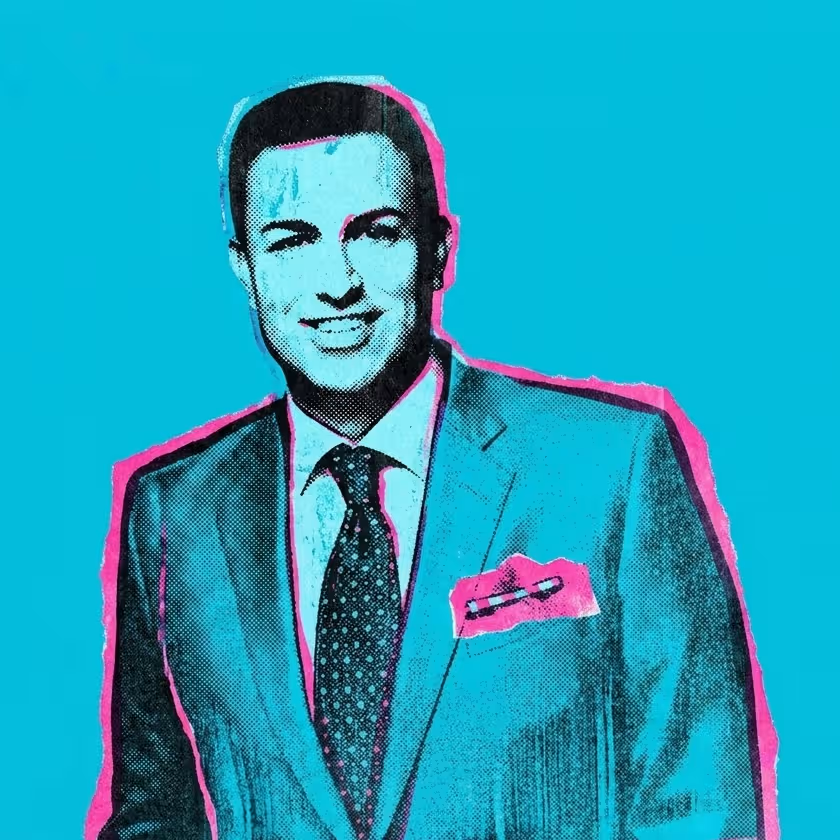
Ryan Roberts is a startup lawyer and represents technology companies through all phases of the startup process, including incorporation, seed & venture financings, and exit transactions. Click here to learn more about his practice.


View Comments
[...] recently read an interesting post over on The Startup Laywer explaining why asking an investor to sign an NDA will at best get you laughed out the building. I [...]
[...] Capital Firms. They won’t grant you a meeting. If you do get a meeting they won’t sign your nda. And you’ll be lucky if your startup gets any funding. Making matters worse, they could be [...]
If the idea of signing a NDA is not good – then can I make some confidential (or non confidential) agreement such that –
My company "A" brought a proposal of a overseas government project – very profitable for VCs. VC1 likes it. "A" wants to make sure no "B" comes with the same proposal while "A" is probably shopping with VCs. Is there any agreement "A" can have signed by VC1 to make sure time is not wasted or lock the VC1 party for "A"?
Is there any kind of agreement that VCs like to do instead?
Thanks.
[...] and DO NOT ASK a VC to sign an NDA. Ryan explains, “Asking a VC to sign a NDA is tantamount to splitting 10’s at the blackjack table. [...]
[...] So next time you chat with me or anyone else, forget the NDA. [...]
On the other hand do these VC's require the entrepreneur to document that they have been talking to other people (third parties) about their "the next greatest thing" only under the protection of an NDA ?
I thought that is needed when it comes to patents etc.
– Stephan
[...] the links to the NDA articles if you’re interested in more reading: Startup Lawyer on NDAs (here), Brad Feld (here), Jason Mendelson (here) and Guy Kawasaki (here in the first [...]
[...] are the links to the NDA articles if you’re interested in more reading: Startup Lawyer on NDAs (here), Brad Feld (here), Jason Mendelson (here) and Guy Kawasaki (here in the first [...]
[...] today’s world, VC and more professional Angel Investors don’t sign NDA’s and the reason is simple, they see same ideas many times over and don’t really want to be in [...]
My understanding is that making any PUBLIC disclosure of the proprietary elements of an invention will essentially leave you with one year to file a patent application in the US, and possibly void an international application.
In which case, how to handle a big "forum" presentation with many people in the room one has not even met?
Or on the other hand, a meeting with a VC firm or angel group when everyone has at least shaken hands?
I guess I think I should make a brief non-disclosure disclaimer "This information is confidential and in no way represents a public disclosure"…
Is that legit?
Thanks, North.
[...] of start-up companies with great ideas, but the truth is that over 90% of them will fail, and investors don’t want to waste their time knowing this. It’s generally not the idea that gives a product value, it’s the [...]