Last Updated on April 29, 2026 by Ryan Roberts
If you’re looking at online cap tables like Carta, Pulley, Morgan Stanley’s Shareworks, or Fidelity’s Private Shares, the short answer is: they’re a helpful secondary record and workflow tool, not the actual “truth” of your capitalization. They can be great for issuing and tracking equity, running option exercises, generating certificates, and modeling financings. But the platform’s outputs are only as good as (1) what you put in and (2) what the software is willing to support.
To be clear: this isn’t an article telling you to avoid online cap tables. For most startups, using a reputable platform is the right call. The point is just to be honest about the limitations, the trade-offs, and the ways these tools can create blind spots if you treat the software as the source of truth.
That’s why this topic shows up in venture financings and M&A: when money is on the line, everyone wants to know who owns what, under what terms, and whether the mechanics actually match the documents. A clean dashboard helps. A mismatch between the dashboard and your company’s capitalization does not.
I’ve been familiar with Carta since the very early days—back when the CEO was personally doing company onboardings—so I’ve watched these online cap tables evolve from “cap table replacement for spreadsheets” into full equity ops systems.
One early telling shift: Carta originally pitched itself (at least in spirit) as “replacing your startup lawyer” for cap table matters. They later walked that back and, to their credit, repositioned the product as something that works with your startup lawyer…welcoming counsel into the process rather than trying to route around them.
Either way, the operational reality is the same: someone at the company has to run point on the platform and keep it current. And the more you rely on Carta, Pulley, Shareworks, Private Shares, etc. instead of using your startup lawyer for day-to-day cap table management, the more important it is to have a clear internal owner at your company who is responsible for updates, cleanup, and reconciliation against the actual documents.
Being on a platform is like using a bookkeeping system: it’s miles better than chaos, but it doesn’t make your numbers automatically right.
What online cap tables are genuinely great at
Most founders end up on an online cap table system for three practical reasons, and those reasons are legitimate:
1) Day-to-day equity administration
If you’ve ever tried to manage vesting schedules, early exercises, repurchases, or terminations in a spreadsheet, you already know why these tools exist. A good platform helps you keep the moving pieces in one place.
2) Option exercises and (related) logistics
Platforms can streamline option exercises: notices, exercise calculations, withholding workflows (where applicable), and keeping the “what happened when” history organized. That’s real value, especially once you have more than a handful of employees.
3) Issuances, certificates, and investor visibility
Many platforms are useful for issuing stock certificates (or at least maintaining certificate numbers/records), circulating statements, and giving investors a portal view instead of emailing PDFs forever.
In other words: as an operational system, this stuff is great.
The part founders usually miss: online cap tables are a secondary source
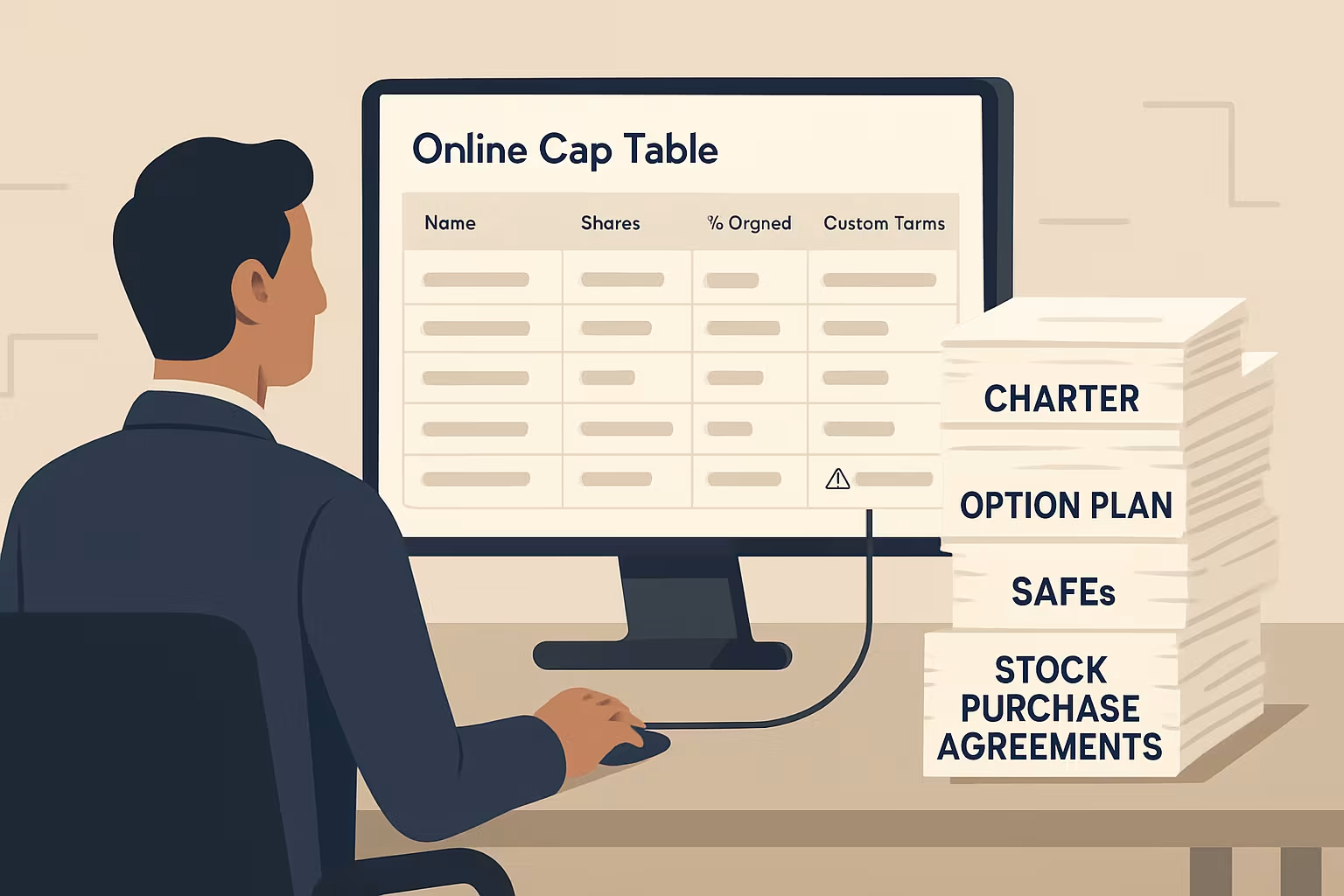
In practice, a cap table platform is often a secondary source that summarizes primary sources.
The primary sources are the things that actually define the rights and numbers: your charter, option plan, purchase agreements, SAFE/note forms, and the actual financing documents. The platform is the translated version of that reality. Sometimes the translation is perfect. Sometimes it’s “close.” And in venture, “close” is where friction lives.
If you’re thinking, “Okay, but isn’t the whole point that the platform standardizes this?”—yes, to a point. The catch is that platforms standardize what they can standardize.
Where online cap tables break down: customization (or lack of it)
This is the practical downside people don’t talk about enough: you’re constrained by the software’s model.
Most platforms are built around common venture patterns. That’s a feature. It’s also a limitation.
Here are a few ways that shows up:
1) Conversion mechanics that aren’t a simple fixed price per share
Some deal terms don’t resolve neatly into “$X.XX per share.” A classic pain point is when a document uses a formula for conversion price (or other economics) instead of a fixed number for a class or series of stock.
Even if the formula is straightforward, and even used for calculations of SAFEs or convertible notes, the platform may not support it cleanly. Then you end up with one of three outcomes:
- you approximate it in the system (and write notes explaining the approximation),
- you force the term into the platform’s structure (and risk being wrong), or
- you track it off-platform (which defeats part of the point).
None of these options are fatal. They just mean: don’t confuse “the platform can’t model it” with “the term doesn’t exist.”
2) Preferred stock terms that are “market,” but not template-market
Venture financings are standardized-ish, not identical. The moment your deal has a bespoke wrinkle like non-standard dividends, unusual conversion protections, special side letters, multiple closings with different economics, you can find yourself wrestling the UI instead of managing your cap table.
A platform is opinionated software. It has opinions about what a cap table should look like.
3) The “vendor captivity” issue: you’re not just buying software, you’re buying future pricing
Another under-discussed reality: switching cap table platforms later is annoying. Sometimes very annoying.
Once your company has:
- multiple classes/series of stock,
- an active option program with many historical grants,
- exercises, cancellations, repurchases,
- SAFEs/notes with different terms,
- and a history of amendments…
…migrating from Carta to Sharepoint or Pulley to Private Shares is no longer “export a CSV and move on.” It becomes a project. And because it’s a project, you’re somewhat held captive to future price increases.
This doesn’t mean you shouldn’t use a platform. It means you should treat vendor choice like an infrastructure decision:
- What will this cost now, and what might it cost when you’re bigger?
- What’s included vs. add-on modules?
- How painful will it be to leave if you need to?
- Do you have access to your data in a usable format?
Founders rarely regret choosing a reputable platform. They sometimes regret not thinking one step ahead about switching costs.
A quick “theory vs. reality” check
Theory: “The platform will keep everything clean and automated.”
Reality: The platform will keep everything clean and automated within the boundaries of its model.
If your company stays inside common venture rails, it’s smooth. If you go slightly off-rail such as custom conversion mechanics, non-standard preferred terms, unusual secondary transactions, the system may still work, but you’ll spend time managing the gap between legal economics and software representation.
The best way to think about it: the platform is like an autopilot designed for normal flight paths. It’s excellent… until you’re landing in weather.
The practical takeaway on online cap tables
If you remember one thing, remember this: an online cap table is a powerful admin system and a convenient summary, but it’s still a secondary representation of your equity. Use it heavily. Just don’t assume it can model every bespoke term, and don’t ignore the switching-cost reality once you’re deeply onboarded.
What actually matters:
- the platform keeps day-to-day equity operations sane (grants, vesting, exercises, certificates, reporting)
- the platform’s model matches the economics you’ve actually agreed to (especially around conversion and preferred terms)
- you understand where the software is simplifying or forcing assumptions
What usually doesn’t:
- obsessing over tiny interface differences between vendors early on
- assuming “we’re on [Platform]” will end diligence questions by itself
What you should do differently next time:
- before you commit, test the platform against the non-standard terms you might realistically have (especially conversion mechanics)
- ask blunt questions about data export, migration support, and pricing trajectory
- document any “workarounds” you use so your future self (and future finance team) isn’t reverse-engineering the logic under pressure
Quick FAQs
Should I use an online cap table at seed stage?
If you’re issuing options or planning a priced round, it’s usually worth it. If you have two founders and one SAFE, a spreadsheet can still be fine.
Can the online cap table handle every venture financing structure?
It handles common structures very well. It can struggle with bespoke economics (especially formula-based conversion mechanics for stock) or unusual edge cases.
Am I locked in once I pick one?
Not legally, but practically: switching online cap tables later can be time-consuming and expensive. Treat the initial choice as an infrastructure decision, not a casual subscription.