If you’re raising a seed or Series A round, here’s the short answer: most diligence issues are fixable, but a small few will make an investor walk, either because they create uncapped downside, uncertainty about ownership, or a cleanup job that will outlast the deal momentum. The hard part isn’t spotting “a problem.” It’s sizing it.
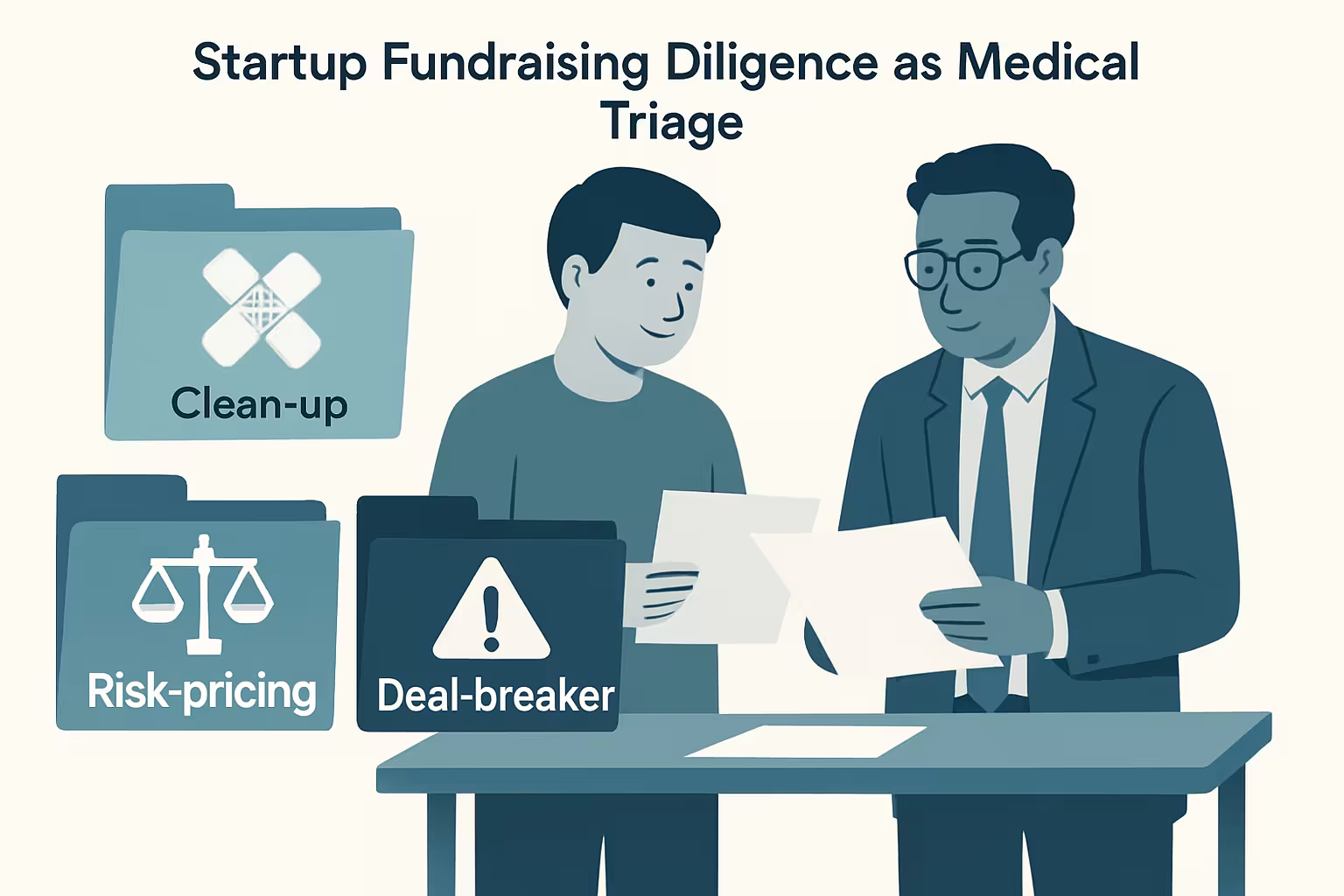
This applies to you whether you’re the founder trying to avoid an avoidable faceplant in legal due diligence, or the investor trying to decide what to underwrite versus what to demand gets fixed before signing. The biggest misconception I see is founders treating diligence like a pass/fail test. In real venture financing, diligence is closer to triage: what needs a bandage, what needs surgery, and what’s contagious enough that nobody wants to be in the room.
And yes, it matters because your leverage is not constant. When you’re in the middle of a competitive process, you can often live with “we’ll fix it post‑close” language. When you have one interested fund and a shrinking runway, the same issue magically becomes “a deal issue.” That isn’t hypocrisy. It’s incentives and risk allocation doing what they always do.
A practical mental model: three buckets that investors actually use
In a clean-room world, diligence is about learning. In the real world of venture capital, diligence is also about deciding what risk the investor is willing to own, what risk gets pushed back to you, and what risk makes the whole thing not worth the effort.
Most issues fall into one of three buckets:
Clean-up items: Real problems, but they’re bounded in cost/time and don’t change who owns what or whether the company can operate. Think “missing signed invention assignment from a contractor” or “cap table spreadsheet doesn’t match the charter.”
Risk‑pricing items: The issue might be fine, but it changes the economics, the structure, or the protections the investor wants. Think “material customer contract is terminable at will,” “there’s a threatened IP claim,” or “regulatory posture is gray.”
Deal‑breakers: The issue creates uncapped downside, existential legal risk, or core uncertainty that can’t be solved fast enough to keep the deal alive. Think “you don’t actually own the IP,” “the charter is invalid,” or “there’s a fraud allegation the investor can’t diligence away.”
To decide which bucket you’re in, investors tend to look at a few repeatable severity drivers:
Is the downside capped? A known cleanup cost is one thing; an open-ended claim or compliance exposure is another.
Does it touch ownership? Anything that clouds the cap table, the charter, or IP ownership gets serious fast.
Can it be fixed quickly? “We can fix it” is not the same as “we can fix it before momentum dies.”
Does it signal a bigger pattern? One sloppy document is annoying; a culture of sloppiness is a governance risk.
Who bears the risk after closing? In venture financing, there’s usually no broad post-close indemnity the way you might see in M&A. If the investor can’t push the risk back to you, they may just avoid it.
Here’s what founders often over‑optimize: they treat every diligence question like it’s equally dangerous, and they try to “win” diligence by arguing. In practice, you get much more mileage by (1) quickly classifying the issue, (2) proposing a credible fix or mitigation, and (3) keeping the process moving.
Three common diligence findings—and when they actually kill a round
Example 1: Missing invention assignments (usually a clean‑up item, sometimes a deal‑breaker). If you used contractors early on and don’t have signed invention assignment agreements, that’s a classic startup company diligence cleanup. In most venture financings, it’s fixable: you track down the people, get signatures, and paper the file.
It turns into a deal‑breaker when you can’t get the signatures (someone disappeared, is hostile, or is demanding a payout), and that person plausibly touched core IP. At that point, the investor isn’t being picky. They’re looking at a company that may not own the thing they’re funding.
What you do differently: don’t wait for diligence to discover this. Run a lightweight “IP ownership audit” before you start fundraising: list every person who wrote code or designed product, confirm what paper exists, and fix gaps while you still have time and goodwill…and are not in a time crunch.
Example 2: Cap table and charter inconsistencies (almost always a risk‑pricing item). The cap table is where startup law becomes math. If your spreadsheet doesn’t match the company’s charter, option plan, and board consents, you’ve created uncertainty about who owns what.
In most seed and Series A deals, this doesn’t kill the round. It slows it down. Investor counsel will push for a cleanup as a closing condition: ratifications, corrective filings, updated equity records, sometimes a “bring‑down” certificate that says (politely) you’re not lying.
It becomes a deal‑breaker when the fixes require third‑party consents you don’t have, the recordkeeping is so unreliable that nobody can confirm the fully diluted number, or you have equity issuances that look flat-out unauthorized. The practical point: if your ownership story is fuzzy, investors will assume the worst case until you prove otherwise.
Example 3: A key customer contract that can disappear (usually risk‑pricing). Suppose 40% of your revenue is tied to a customer that can terminate on 30 days’ notice, or has a change‑of‑control clause that spooks them. Founders see this and think, “But the relationship is great.” Investors see concentration risk with a legal lever attached.
Most of the time, this is not a deal‑breaker. It’s a negotiation about price, milestones, or structure. You might see the investor ask for (a) tighter disclosure, (b) a plan to diversify revenue, or (c) a condition that you’ve at least discussed the financing with the customer or alternatively, a requirement to amend that customer contract to lengthen the notice required for termination (depending on sensitivity). The investor isn’t demanding perfection. They’re trying to avoid being surprised.
This can tip into deal‑breaker territory if the “customer contract” is not actually enforceable, if there’s a live dispute that could crater revenue next quarter, or if diligence uncovers facts that suggest you’ve been recognizing revenue aggressively. Investors can price risk. They struggle to price uncertainty about whether the numbers are real.
Where leverage and stage change the outcome (and where they don’t)
Most of what I’m describing is anchored to seed and early priced rounds, where the deal is moving fast and the goal is to get comfortable enough to wire, not to recreate a public-company disclosure regime.
If you have leverage (multiple term sheets, a lead who wants the deal done, a market that rewards speed), investors will usually accept more items in the “clean up post‑close” bucket. You’ll still have to disclose issues, but the fix can be sequenced.
If you don’t have leverage (single investor, time pressure, or a skittish market), the exact same issue gets treated more harshly because the investor knows you need the deal more than they do. They’ll ask for pre‑close fixes, stronger closing conditions, or simply more time…often all three.
As you get later stage, diligence looks more like M&A: bigger checks, more stakeholders, and more focus on compliance, revenue quality, and repeatability. The bar for “we’ll fix it later” gets higher. But the categories don’t change…clean-up, price, deal‑breaker. The thresholds do.
Theory vs. reality: what founders think diligence is, versus what it actually drives
Theory: diligence is where the investor decides whether your company is “good.”
Reality: diligence is where the investor decides whether they can explain the risk internally (and to their IC), whether they can live with it given ownership and price, and whether the legal work will fit into the deal timeline.
In real deal rooms, a surprising amount of the conversation is not “is this bad?” but “is this knowable?” If an issue is knowable and bounded, investors can usually underwrite it—even if it’s annoying. If it’s unknowable, the investor starts to imagine edge cases, and edge cases are where deals go to die.
This is why the best founder move is often a good memo (short), not a good argument. When you surface an issue, pair it with: what happened, what’s true today, what the path to “clean” looks like, and what you need from the investor (usually: time, not permission).
If you remember one thing: make the risk small, knowable, and schedulable
If diligence feels like an investor looking for reasons to say no, you’re not crazy. But you can influence the outcome by changing what the risk looks like. Investors will tolerate a lot when the downside is capped, the facts are clear, and there’s a credible plan.
Before fundraising, do a fast internal diligence sweep: cap table, charter, option plan, key contracts, IP assignments, and basic compliance.
When an issue pops up, classify it (clean-up vs. price vs. deal‑breaker) and say which facts make you confident.
Offer a fix with a timeline. “We’ll handle it” is noise; “we’ll have signed assignments from X and Y by next Friday” is signal.
Don’t over‑optimize cosmetic diligence items if you have a real ownership or revenue-quality problem underneath.
Quick FAQs founders actually ask
Should I disclose a problem if I think it’s minor? Usually, yes. If it’s discoverable in diligence or might pop up post-closing, surprising the investor is worse than the underlying issue. The goal is controlled disclosure with a fix plan.
Should we narrow or rewrite reps & warranties just to avoid listing something on the disclosure schedule? No. Reps and warranties are meant to allocate risk based on what’s true, not to be engineered around a known issue. Over-revising them to “paper over” a fact can create bigger problems: it may misalign expectations with the investor, invite tougher diligence questions, and undermine credibility if the issue later surfaces. The better approach is straightforward disclosure (with context) and a practical mitigation or cleanup plan, or just disclosing an item, rather than trying to draft your way out of the disclosure schedule.
Can an investor turn a clean-up item into a deal‑breaker? They can treat it that way if (a) it’s really signaling something bigger, or (b) the deal has lost momentum and they’re looking for an exit ramp. That’s another reason to fix the predictable startup law-related issues before you’re mid‑process.
What’s the fastest way to lower diligence risk before fundraising? Get your ownership story airtight (cap table + IP). If those are clean, most other issues become negotiable instead of existential.
Ryan RobertsStartup Lawyer
Ryan Roberts is a startup lawyer with more than two decades of experience advising on venture financings and M&A transactions totaling more than $1 billion. He is the author of the Amazon bestselling startup law book Acceleration.