Last Updated on April 29, 2026 by Ryan Roberts
TL;DR: In most private-company startup acquisitions, it’s normal for the buyer to hold back a portion of the purchase price in an escrow (or as a holdback) for 12 to 18 months to cover post-closing surprises, so the real question is not “why isn’t my money here,” but how big it is, how long it lasts, and how easy it is for the buyer to make a claim.
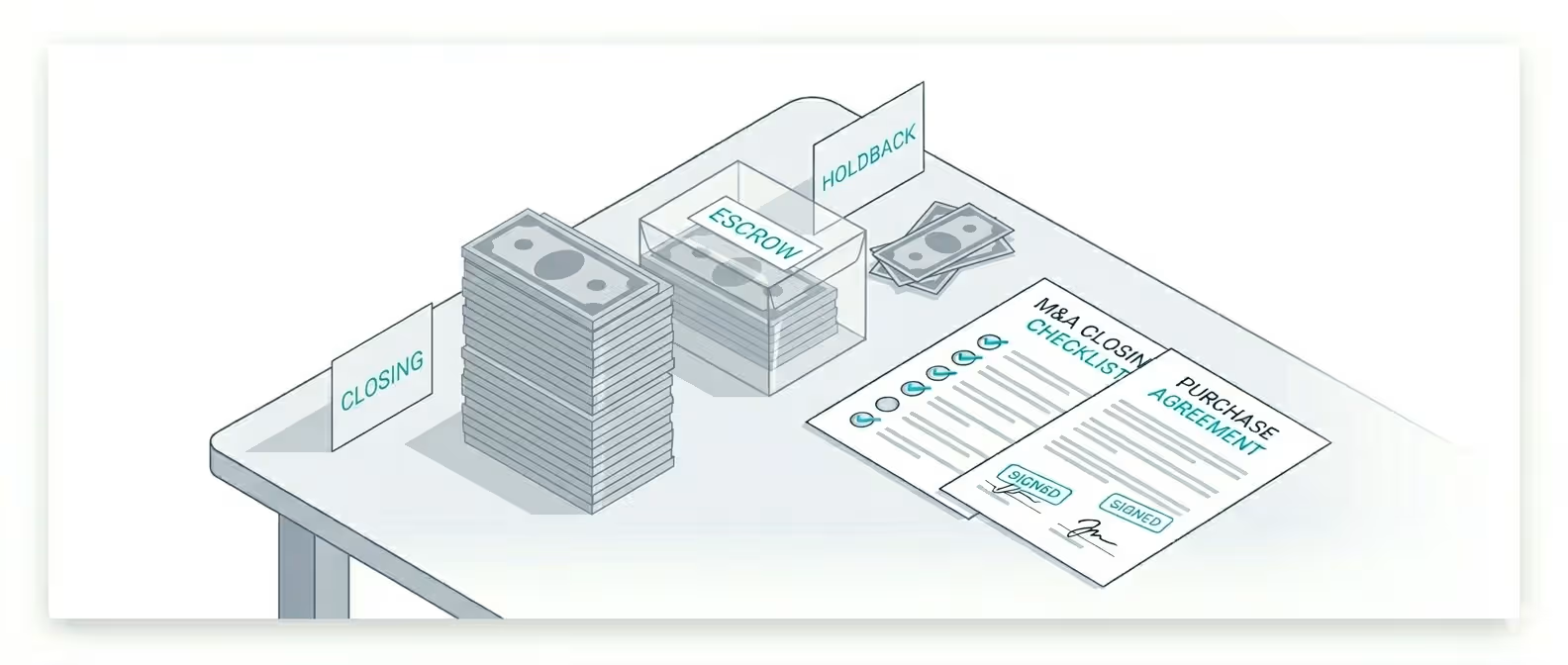
If you’re selling your startup, here’s the part that can feel like a prank: even on a “cash at close” deal, some of the purchase price often does not show up at closing. It gets parked in an escrow (held by a third party) or treated as a holdback (the buyer keeps it) to cover specific post-closing risks. Usually that means breach of reps and warranties, taxes, employee claims, or the contract you were sure was assignable.
This mostly matters if you’re a founder or key stockholder in a private-company M&A deal, because the dollars you’re counting on for taxes, lifestyle, and closure may arrive in two (or more) installments. The key misconception is: “We agreed on the price, so I’ll get the price.” In practice, the signed number is the headline. The escrow or holdback is the fine print that decides how much money is actually in your account on Day 1.
Let’s cover why this exists, what market norms usually look like, and how to keep it from quietly turning your “closing” into a 12 to 24 month waiting room.
What is escrow and holdback (and why buyers like them)
An escrow is a portion of the purchase price held by a neutral third party (an escrow agent, often a bank) and released later if certain conditions are met, or not released if there’s a valid claim.
A holdback is similar economically, but structurally simpler. The buyer keeps a portion of the price and agrees to pay it later, subject to the same kinds of adjustments and claims.
They’re both forms of risk allocation. The buyer is saying: “I’ll pay you, but I’m not paying all of you until I’m confident I didn’t buy a problem.”
Founders sometimes hear this as mistrust. It’s usually not personal. In deal terms, escrow and holdback are closer to a deductible on an insurance policy than an accusation.
Why escrow and holdback show up in real startup acquisitions
Most acquisition agreements include a set of representations and warranties (reps), which are statements you’re making about your startup as of signing and closing. Examples include:
- The company owns its IP.
- Financial statements are not misleading.
- There are no undisclosed lawsuits.
- Key contracts are valid and enforceable.
- Taxes have been properly filed and paid (or properly reserved).
- Employees were classified correctly.
- There are no hidden liens.
If those statements turn out to be wrong, the buyer wants a practical way to recover without chasing dozens (or hundreds) of former stockholders who have moved on with their lives and money.
Escrow or holdback is that mechanism.
The common founder assumption (and why it’s incomplete)
The founder assumption is usually: “If there’s a problem later, the buyer can sue.”
True. It is also inefficient.
In real deals, the buyer does not want to litigate to recover $300,000 over a misclassified contractor or an overlooked sales tax nexus issue. They want a clean contractual path: submit a claim, pull from escrow, move on.
And the seller group usually does not want to be sued either. Escrow and holdback are a compromise that makes indemnification workable.
How escrow and holdback work in practice: the three buckets that matter
Escrows and holdbacks show up in three main places. If you understand these buckets, you understand most of the negotiation.
1) General indemnity escrow (the “reps and warranties” bucket)
This backs the seller’s indemnification obligations for breaches of reps and warranties and covenants.
Typical mechanics:
- A percentage of purchase price set aside (often single digits to low teens, depending on the deal).
- A survival period (often 12 to 18 months for general reps).
- A claims process (notice, opportunity to dispute, escrow agent release rules).
The buyer is not trying to keep your money forever. They’re trying to ensure there is money available if something goes wrong within a reasonable window.
2) Special escrows (tax, litigation, IP, and “known issues”)
If there’s a known risk area, the buyer may ask for a separate, purpose-built escrow with its own rules.
Common examples:
- Tax escrow (payroll, sales and use, international, or state nexus issues)
- Litigation escrow (existing claim or credible threat)
- IP or ownership escrow (assignment gaps, open-source concerns, or contractor IP issues)
- Working capital true-up holdback (more on this below)
These can feel annoying, but they are often more negotiable than the general escrow because they have a tighter scope. If you can narrow the risk, you can often narrow the escrow.
3) Purchase price adjustments (working capital, net debt, cash)
This one sounds like accounting, but it is purchase price.
Many deals are structured with a working capital adjustment. In plain English: the buyer expects the company to have a normal amount of cash, receivables, and payables on the closing date. If it has less than the agreed “target,” the price drops. If it has more, the price increases.
Because the final numbers are not always known at closing, the buyer often holds back funds pending the post-closing calculation and dispute window.
Founders experience this as: “Wait, we closed. Why are we still negotiating money?”
Because the math is not final until after closing.
Market norms (and what you can realistically push)
There is no universal “standard” escrow. But there are patterns.
In a typical private-company startup M&A deal:
- A general indemnity escrow or holdback is common.
- The duration is often tied to rep survival (commonly about a year for general reps, longer for certain fundamentals).
- The size tracks perceived risk, diligence quality, buyer leverage, and how fragmented the seller base is.
Here is the practical point: you can negotiate escrow economics, but you usually negotiate at the margins unless you have leverage.
Leverage looks like:
- Multiple bidders.
- A strategic buyer who cares more about speed than perfect risk allocation.
- A startup that is unusually diligence-ready (clean IP chain, clean cap table, clean employee classification, clean taxes).
- A buyer that is already familiar with your space and sees fewer unknowns.
If you do not have leverage, the best use of your time is often not fighting the existence of escrow. It is tightening the terms: what claims can be made, how quickly they must be made, and when money gets released.
The emotional part of escrow and holdback (why this feels worse than it “should”)
Escrow and holdback hit founders differently than most legal terms because they collide with a psychological milestone. Closing is supposed to be the finish line.
Then the contract says:
- Some of your money will arrive later.
- The buyer can claim it.
- You might have to argue about it.
Even if the escrow is small, it can feel like the buyer is keeping you on a leash.
That reaction is normal. It is also a signal: treat escrow as a post-closing relationship management issue, not just a line item.
Two practical implications:
- Your job is not over at closing. You may have 12 to 18 months of responding to claims, providing documentation, and resolving disputes.
- The founder who stays organized post-close usually protects more value than the founder who treats escrow as “future me’s problem.”
A tech analogy that actually maps to the deal
Think of escrow and holdback like a staged rollout with a rollback plan.
When you deploy a major system change, you push most traffic, but you keep guardrails. You use feature flags, canaries, monitoring, and a rollback path because you cannot perfectly simulate production.
A buyer is doing the same thing with your startup. Closing is the deployment. Escrow is the rollback budget if production behaves differently than the diligence environment.
You can argue that your code is great. The buyer will still want monitoring.
Concrete examples (the kinds you’ll actually see)
Example 1: The contractor IP gap
Your startup used contractors early. Most signed invention assignments. One did not. Six months after closing, the buyer discovers it during internal compliance cleanup.
Buyer claim: cost to fix plus risk premium, sometimes a settlement. Escrow becomes the easy source of funds.
What matters in negotiation: can you cap this exposure, narrow it to actual documented remediation costs, and include a cure process before money is pulled?
Example 2: Sales tax nexus surprise
Your startup sold into multiple states. You assumed SaaS meant “no sales tax.” Some states disagree.
Post-close, buyer finance runs a nexus analysis and identifies exposure. They file voluntary disclosure agreements, pay back taxes and penalties, then claim indemnity.
This is why tax escrows exist and why buyers push for longer survival on tax reps.
Example 3: Working capital holdback turns into a mini-fight
At closing, your startup has been operating lean and delayed paying a few vendors to preserve runway. Normal startup behavior.
The buyer’s post-close working capital calc says payables were unusually high at close, so working capital was below target, so purchase price should be reduced.
Founder reaction: “That’s not a liability. That’s just how startups operate.”
Buyer reaction: “It is a liability, and I’m paying it.”
This is where holdbacks become less about fraud protection and more about landing the economics where the buyer expected.
Where theory and reality diverge
Theory: Escrow is only for true surprises and real breaches.
Reality: Escrow can become the default pot of money for anything arguable.
This is not always bad faith. It is incentives:
- The buyer has a process, internal auditors, and sometimes an earnout mentality even when there is no earnout.
- The seller group is fragmented, tired, and motivated to move on.
- The escrow agent will not adjudicate merits. They follow the contract.
So the “real” battle is not whether escrow exists. It is whether the agreement prevents escrow from becoming an all-purpose coupon code.
Terms that actually change outcomes:
- A clear definition of a valid claim.
- Materiality qualifiers, and whether they are “scraped” for indemnity purposes.
- Baskets or deductibles (does the buyer eat the first $X of losses?).
- Caps (how much can be recovered in total?).
- Procedural protections (notice detail, timing, dispute rules).
- Release mechanics (automatic release unless a claim is pending, versus funds just sitting).
- No double-dipping (no recovery via adjustment and indemnity for the same issue).
If you are going to spend negotiating capital, spend it there.
What you might be over-optimizing
Founders often over-optimize the escrow percentage to the second decimal place.
It is understandable because it is the number you can point to. But in many deals, the escrow terms matter more than the escrow size.
A slightly larger escrow with a tight survival period, a clear cap, a real basket, and an automatic release schedule can be better than a smaller escrow that is easy to claim against and slow to release.
A practical question to ask while staring at a draft:
“Does this escrow behave like a reasonable risk backstop, or like a buyer-controlled slush fund?”
Practical negotiation points that are often achievable
- Shorten the survival period for general reps, and keep longer survival only for truly fundamental items.
- Stage the release (for example, some released at 6 months, the rest at 12 to 18).
- Tighten claim notice requirements so “we might have a claim” does not freeze funds indefinitely.
- Clarify a cure process. If something can be fixed, give the seller side a chance to fix it before money is pulled.
- Define “losses” carefully. Do they include internal overhead, consequential damages, or business multiples?
- Push for a real basket or deductible, especially where the buyer is likely to find small issues.
- Avoid double-dipping where the buyer recovers twice for the same underlying problem.
Some of these are market. Some require leverage. But these are the levers that change how much money you keep.
If you remember one thing
Escrows and holdbacks are not a moral judgment on your company. They are a tool buyers use to make indemnity real.
The smartest approach is to assume some delayed money is normal, then negotiate the rules so claims are limited to real issues, the timeline is finite, and the release is predictable.
If you are about to sign, look for three things:
- When does the money actually get released, and is it automatic?
- What is the easiest path for the buyer to make a claim?
- What stops small, arguable issues from turning into escrow gravity?
FAQs founders actually ask
Do I always have to agree to an escrow or holdback in an acquisition?
In most private-company acquisitions, some form of escrow or holdback is common. If you have real leverage (multiple bidders, unusually clean diligence, strategic urgency), you can sometimes reduce it or replace it with other structures.
What is the difference between an escrow and a holdback?
An escrow is held by a third party and released under an agreed process. A holdback is retained by the buyer and paid later. Economically they can be similar, but escrow can feel more neutral.
Can the buyer just keep the escrow by making a claim?
Not automatically. The agreement usually requires notice and gives the seller side a chance to dispute. But vague claim rights and slow dispute mechanics can delay release, so drafting details matter.
Should you get reps and warranties insurance (RWI) instead of an escrow?
Sometimes, but don’t assume it eliminates the escrow, or even makes sense for your deal. RWI is a policy that can cover certain losses from breaches of reps and warranties, which can reduce the seller’s post-closing exposure and sometimes reduce the size of the escrow. In many startup-sized deals, though, RWI may not be available (or practical) below certain deal sizes, and even when it is available, the premium, underwriting fees, and time burden can fail a basic cost-benefit analysis. Also, RWI has meaningful exclusions, so it typically won’t cover known issues, things disclosed in diligence, and certain categories of risk (tax and forward-looking statements are common pressure points), which is why buyers often still require a smaller escrow or holdback as a retention or deductible.