Last Updated on April 29, 2026 by Ryan Roberts
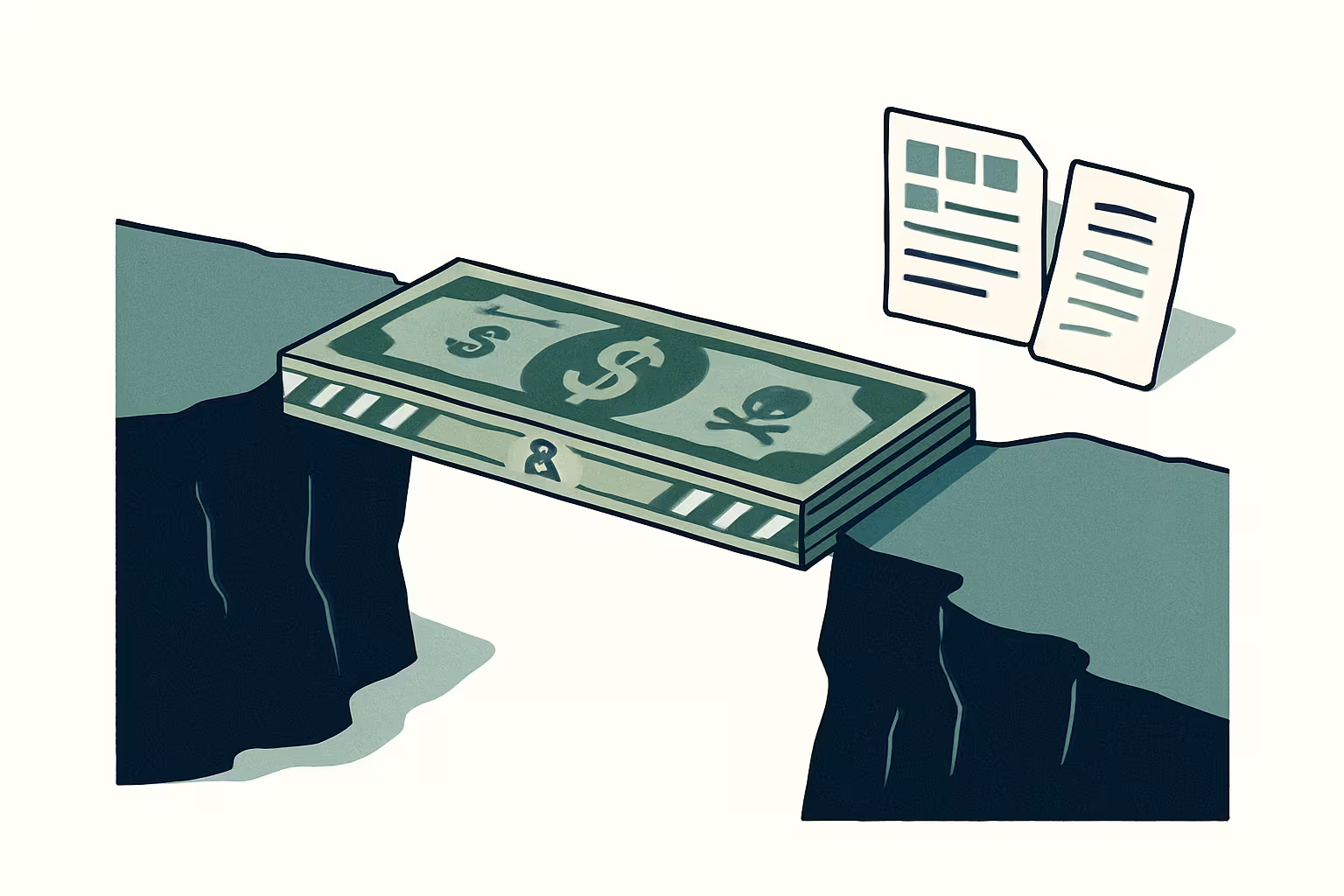
If you’re thinking about “loaning money to your startup,” the short answer is: founder loans can be totally fine as a temporary bridge, but they’re one of the fastest ways to create weird priority fights in a future venture financing if you paper them poorly (or pretend they’re “just informal”). The risk isn’t that investors hate founders funding their own companies. The risk is that a loan quietly turns you into a creditor, and creditors have rights that don’t play nicely with how early-stage companies are usually funded, priced, and sold.
This mostly matters at the pre-seed and seed stages, where you’re still assembling a real cap table and you don’t have the clean “institutional” deal terms yet. The biggest misconception is thinking, “It’s my money, so it can’t hurt me.” In startup law, you can absolutely hurt yourself with your own money.
Why founder loans show up (and why it’s tempting)
You’re short on cash. Payroll is coming. AWS doesn’t care about your runway narrative. Your customers are “close” (which is founder-speak for “not signed”). You have three options:
- Put in personal money
- Raise outside money (which takes longer than your bank account would like)
- Don’t pay the bills (which is not a strategy, it’s an event)
A founder loan feels like the grown-up version of option #1. You’re not “giving” the company money, you’re lending it, which sounds safer. You can tell yourself you’re being prudent: if the company works, you get paid back; if it doesn’t, well, at least you tried.
A lot of founder “loans” don’t start as a conscious financing decision. They start as you covering a bill here, a vendor there, then reimbursing yourself “later.” You’re not trying to become a creditor—you’re just trying to keep the company alive. The issue is that those drips can quietly add up to a number that suddenly feels real, and at that point you understandably want (a) credit for having funded the business and (b) a clean way to unwind it without hurting the company.
And if you’ve read enough about venture financing, you may also think: “Investors like to see founders have skin in the game.” True. They just usually mean equity risk, not a repay-me-first instrument sitting above everyone.
The key founder loan distinction: loan vs. contribution vs. SAFE
Most of the potential mess here comes from mixing up three different buckets.
1) A true loan (debt)
This is “company owes you money,” typically evidenced by a promissory note. A real loan usually has:
- a principal amount,
- an interest rate,
- a maturity date,
- and a statement that it’s debt.
Once you do that, you’re not just a founder. You’re a creditor.
2) A capital contribution (equity funding without new shares)
This is “I’m putting money into the company and not expecting repayment as a debt.” Practically, it often gets treated like paid-in capital. There may or may not be additional shares issued, depending on how it’s structured.
This is generally the cleanest if you truly don’t need repayment before an outside financing. But, you typically want to avoid selling common stock at a fixed price, especially early, and then you have to figure out what valuation.
3) A convertible instrument (SAFE or convertible note)
This is “I’m funding now, and it converts into equity later,” usually at a discount and/or valuation cap. This is the dominant early-stage market norm in venture and startup law land.
A founder can use a SAFE too, but it’s less common, for a simple reason: you already own the company. The instrument is mostly useful for third parties. For founders, the clean question is usually “is this debt that gets repaid, or equity risk like everything else?” But it’s not uncommon to see a founder use this method but still somewhat struggle with the economic terms like a discount or price cap.
Where founder loans go sideways in practice
Here are the issues that actually drive outcomes.
Problem #1: You accidentally create a repayment priority fight
In a vacuum, a $50k founder note seems harmless. In the context of a seed round, it can become the main diligence issue.
Investors don’t love seeing cash they just put in immediately leak back out of the company to repay insiders. They’ll ask, sometimes bluntly: “Are we funding the business, or paying founders back?”
Market norm: new venture capital money is supposed to buy runway and growth, not refinance founder debt. Not never, but investors treat it as something that needs a specific rationale and tight limits.
What happens in a real term sheet negotiation:
- You get a financing offer.
- Diligence discovers founder debt.
- The investor proposes: “Repay it at closing” or “Convert it” or “Subordinate it.”
- You realize you don’t have a clean answer because the “loan” was a Google Doc and vibes.
Problem #2: A maturity date becomes a ticking legal clock
A promissory note with a maturity date isn’t just a formality. When it matures, the company technically owes the money then. If it can’t pay, you’re in default territory.
Now, are you going to sue your own startup? Probably not. But defaults have consequences:
- they can trigger disclosure obligations,
- they complicate representations in venture financing documents,
- and they create leverage for the investor to demand cleanup.
If you want to create a founder-friendly situation, don’t give yourself a document that forces you to choose between enforcing it and admitting it’s not real.
Problem #3: Interest is not “free” (and it creates paperwork drag)
Even modest interest provisions add complexity:
- accrual calculations,
- tax reporting considerations,
- and “how much is actually owed now?” questions during diligence.
At the pre-seed/seed stage, you want fewer moving parts, not more. A startup lawyer reviewing your round would rather see a clean cap table and simple instruments than founder debt with bespoke economics. Further complicating the interest issue is if you have in fact ‘dripped in’ the investment into 17 different installments (in addition to creating the legal document that reflects it).
Problem #4: It can look like inside preference, even if you meant well
Put yourself in an investor’s seat for 30 seconds.
You’re about to invest in a company that has:
- founder common stock,
- a SAFEs stack,
- and also founder debt that’s payable before any equity distribution.
Even if the loan was used for payroll and servers, it still reads like: “Founder gets paid back first, then everyone else takes the equity risk.”
That perception matters in venture deals. It affects trust and it changes the negotiating temperature. This is why most investors will want it either repaid or converted, as they won’t want to sit behind your debt after the equity financing.
Problem #5: M&A and wind-down scenarios get messy fast
Here’s where “cap table poison” becomes real.
Imagine a small acquisition. Not a unicorn exit. A decent $8M sale that saves the team and returns something. In an asset sale or merger, the purchase price typically goes to the company, then gets distributed (after paying creditors).
If you’re a creditor, you may be entitled to repayment before equity holders see proceeds.
Now you’re negotiating a sale while wearing two hats:
- founder trying to maximize outcome for the cap table,
- creditor trying to get repaid.
That’s not automatically wrong. But it’s exactly the kind of conflict-of-interest fact pattern that makes acquirers and their counsel ask more questions, request more consents, and slow down closing.
In the worst case, it can blow up deal dynamics inside your own board or stockholder base. There’s a lot of waterfall negotiation at this point, and having founder debt outstanding only further complicates it.
Market norms: what sophisticated investors usually want to see with your founder loan
In most early venture financings, investors are not philosophically opposed to founders funding their companies. They just want the structure to be clean and non-extractive.
Common “market” outcomes I see in practice:
- Treat it as a capital contribution if it’s small and you don’t truly need repayment. (Small is relative and likely under $10k)
- If it must be debt, make it explicitly subordinated to new money and often to ordinary trade payables.
- If there’s a financing coming, convert it into the financing securities (or into a SAFE/note that matches the stack). Getting some economic incentive here isn’t out of the question, but the investor will likely want your conversion to happen “immediately prior to” their investment.
- If repayment is allowed, it’s usually capped and tied to a real liquidity event or excess cash, not “immediately after closing.”
There’s also an unspoken norm: the earlier the stage, the less tolerance there is for bespoke insider economics. Pre-seed companies get financed on simplicity and trust. Complex insider debt reads like the opposite.
The “theory vs. reality” reality check
Theory:
“A loan is safer for you because you get paid back first.”
Reality:
If your company is good enough to attract venture capital, the financing will come with cleanup expectations, and your “priority” will be negotiated. If your company is not good enough to attract venture capital and it fails, your “priority” is often meaningless because there’s no money to pay anyone.
Put differently: founder loans often feel like downside protection. In real startup outcomes, they more often function as upside friction.
That’s why you’ll hear experienced startup lawyers gently steer founders away from founder debt unless there’s a specific reason it needs to exist. Or worst case, manage the founder’s expectation that a relatively large sum of founder loans will get paid back at the next round.
When founder loans are actually a good idea
There are situations where it’s sensible, even investor-friendly.
- Short-term bridge with a clear near-term repayment source
Example: you’re waiting on a signed customer contract with a real payment schedule, or a grant reimbursement, and you’re covering timing. - You’re protecting the company from worse debt
If the alternative is a predatory lender or a merchant cash advance-style product, founder debt can be the least bad option. - You’re doing it to support a priced round mechanics issue
Occasionally, a founder loan can help solve a closing gap or expense issue (tax payments) in a way that’s cleanly documented and repaid as part of the round with full investor awareness. - Later-stage companies with real governance and budgeting
Once you’re later-stage, with a board, financial controls, and proper approvals, insider loans can be treated more like any related-party transaction. The stigma fades when the company is mature enough to manage it.
How to do a founder loan without poisoning your next venture financing
Most founders I talk to are pretty indifferent on structure in the abstract. You don’t care whether we call it a note, a SAFE, or if a small amount, a capital contribution. You care about two things: (1) not doing something that spooks a future venture financing or complicates an acquisition, and (2) not feeling like you donated a meaningful amount of personal money without any recognition. That’s a reasonable instinct, the trick is picking a structure that gives you clarity and “credit” without creating insider priority problems later.
If you take nothing else from this, take this: the “poison” isn’t the loan—it’s the ambiguity and the priority.
Here’s the practical playbook I’d use if you were sitting across the table from me.
1) Decide what you really need: repayment right, or recordkeeping?
If you mainly want to track how much you put in, consider a capital contribution. It’s simple and doesn’t create creditor optics.
If you truly need repayment, own that and paper it correctly.
2) Keep terms boring
Early-stage founder loans should not read like private credit deals.
Avoid:
- aggressive interest,
- weird fees,
- tight maturity dates that create default issues,
- extremely favorable economics that act like a recap to your existing cap table,
- and any security interest (a lien) unless you have an extremely good reason.
3) Get proper approvals
Even in a founder-controlled company, document that the company authorized the debt. If there are other stockholders, consider whether they should consent.
This is basic startup law hygiene and it makes diligence easier later.
4) Make subordination explicit (if you expect venture financing)
If you think venture capital is in your future, assume the lead investor will want founder debt subordinated at the least, but most likely converted into equity. You can bake that in upfront rather than letting it become a closing-week negotiation.
5) Be transparent with investors early
Don’t let founder loans surface as a surprise in diligence. Surprises don’t kill deals often, but they do change pricing, leverage, and trust.
A clean email summary to the lead investor (amount, purpose, terms, and your proposed treatment at closing) goes a long way.
6) Don’t over-optimize the “fairness” math
Founders sometimes obsess over whether the loan should convert at a discount, have interest, or get special treatment relative to other early money.
In most seed deals, that level of optimization doesn’t meaningfully change outcomes. What changes outcomes is:
- whether the company has enough cash,
- whether the cap table is clean,
- and whether the financing can close without drama.
If you want to “win” your next venture financing, optimize for closability, not for squeezing an extra $3k of theoretical economics out of your own bridge money.
The practical takeaway
A founder loan is fine when it’s a simple, disclosed bridge—and it becomes cap table poison when it creates hidden repayment priority or cleanup drama in your next financing or M&A. If you’re early-stage and you’re betting on venture financing later, structure your founder funding so it behaves like founder risk, not like insider seniority.
If you’re unsure which bucket you’re in, consider defaulting to subordinated debt without any conversion mechanics (and just have honest conversations with the prospective investor at the next financing). Fixing founder debt in diligence is almost always more expensive than getting it clean upfront, but sometimes punting the conversation without aggressive documents is easier.
Quick FAQs founders actually ask
Can I just “pay myself back later” without paperwork?
You can, but it’s exactly the kind of informal related-party transaction that becomes a diligence headache. If money is moving, document what it is: compensation, reimbursement, capital contribution, or debt. Plus, a new investor may be a little worried that you’ll rack up ‘unsubstantiated’ debt later, so expect a few additional guardrails in your deal documents.
Will venture investors make me waive or convert the founder loan?
Often, yes. Not because they’re hostile, but because they want new money going into the business, and they want the cap table and creditor stack to be clean. As the amount of your founder loan increases, so does the likelihood that an investor will want it converted to equity rather than paid back.
Is a founder SAFE better than a founder loan (convertible debt or promissory note)?
It can be cleaner for venture financing optics because it behaves like equity. But if you’re a founder, the simplest question is still: are you expecting repayment like a creditor, or are you taking equity risk like everyone else? Answer that first, then pick the instrument.