tl;dr: “50% for $0” is usually a brutal trade: you’re handing over permanent ownership to a venture studio for promised introductions + some operating help…often while the studio’s equity doesn’t vest. If they’re truly acting like co-founders, make them earn it via vesting/milestones. Otherwise, walk. They are trying to make you glorified employees.
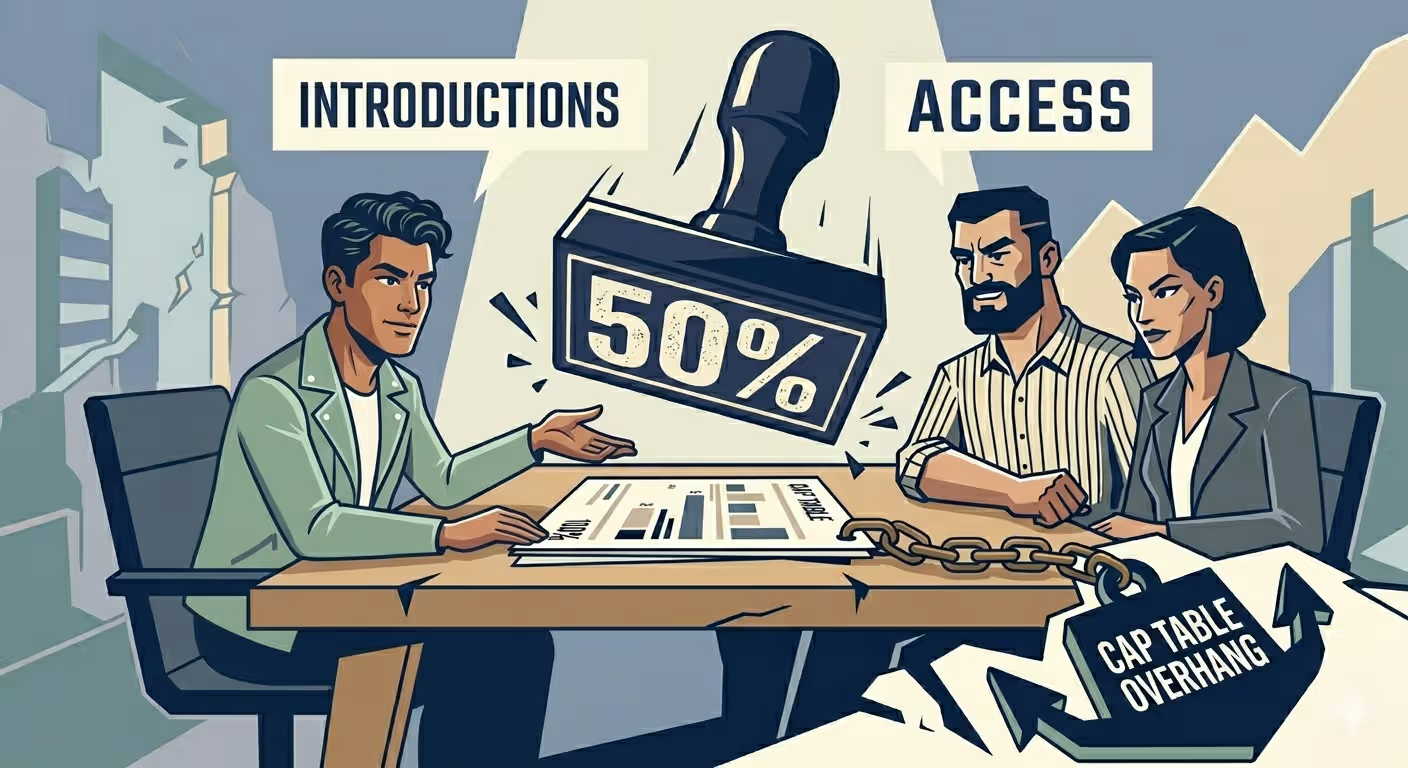
If you’re being offered a “venture studio” deal where they take 50% of your company for little to no cash, treat it like what it is: a financing at a punitive valuation plus a control overlay that can turn you from “founder” into “operator.” Yes, they’ll promise access. But in practice it’s often the most expensive “finder intro” package you’ll ever buy…and at least real finders only get paid if they actually close.
This comes up most often when you have an idea and some early traction but you are not yet funded, and the studio promises money, a team, distribution, or “execution.” The misconception is thinking this is like an accelerator check or a standard seed investor. It is not. Economically, it is closer to selling half your cap table to a service provider before you know whether you even have product market fit.
Let’s break down what a 50% for $0 studio deal is actually buying, why it spooks future venture capital, and what you can negotiate if you still want the studio’s help.
What a “50% for $0” venture studio deal really is
A venture studio is a company that helps create startups by providing some mix of idea generation, operating help, recruiting, product and engineering resources, and sometimes capital.
In exchange, the studio takes equity in the startup.
That general model is not automatically a scam. The problem is the pricing. When the studio takes 50% at formation and you get little or no cash, you have effectively locked in a massive pre seed “valuation” without the one thing that usually justifies giving up equity early: outside capital that lengthens your runway.
Compare that to the old school accelerator deal people still reference, like $25k for 6%. Even if $25k is not much money, it anchors the relationship as an investment, not just a services arrangement with an equity kicker. A 50% grant for $0 does the opposite. It anchors the relationship as the studio owning the company and “letting you” run it.
Once you give away half the company at the start, incentives shift. You may be doing founder level work while holding an ownership stake that looks like a senior hire’s upside, especially after the option pool and the first priced round. That is how founders end up feeling like glorified employees, even if nobody says that out loud.
If you want a quick analogy, think of a lopsided record deal from the late 90s rap. You get access to the studio, the distribution, and maybe a marketing push, but you signed away the catalog before you knew whether you even had a hit. If the song misses, you still gave up the rights. If the song hits, you spend years trying to buy yourself back. It can be like Puff Daddy speaking all over your record while owning your masters…hopefully without all the baby oil. Different “studio”, same type of result.
Why VCs often treat a 50% venture studio stake as a financing problem, not a “founder story”
In a typical seed or Series A diligence process, investors are underwriting two things at the same time: whether the business could work, and whether you will still be motivated and empowered to push through the ugly middle when it does not work yet.
That is why early stage venture deals tend to assume founders own a meaningful majority of the company right before the first institutional priced round. There is no magic number, but when an unrelated third party already owns half the cap table, it immediately raises the question: who is really in control, and who is really getting paid for taking the risk?
Also, dilution is not done after you sign the studio deal. It is just beginning. Add a 10% to 20% option pool, then raise a priced seed round where investors buy, say, 15% to 25% of the company. If you started at 50%, you can end up below a majority before you have raised meaningful capital, and sometimes before you have hired your first executive team.
Example: you and a cofounder split 50% total after the studio takes its 50%. You create a 15% option pool by issuing new equity. On a post pool basis, you now effectively own about 43.5% combined. Raise a seed round selling 20% new preferred stock and you are down to about 34.8% combined. In other words, you are already minority owners right around the time the real work begins.
Then there is governance. Many studio deals are not just “equity.” They come with board seats, consent rights (just by nature of owning 50% or specific named rights), IP assignments, service agreements, and sometimes the ability to replace the CEO. Even if those terms are framed as “standard,” they can collide with what a lead investor wants in a priced round.
From the VC’s point of view, a 50% studio stake is cap table overhang. It functions like a permanent tax on upside. The VC is not just buying into your company. They are also buying into a deal you already made, and that deal might have been priced like you had no leverage, because at the time you probably did not.
The right question is not “Are venture studios good?” It’s “What am I buying, and at what price?”
A venture studio sells a bundle: speed, talent, pattern recognition, and sometimes credibility. You might also be buying access, meaning intros to investors and customers. Those are real things. They are just not automatically worth half your company.
What exactly are you delivering in the first 90 days (people, hours, code, designs, customer intros), and what happens if it slips?
Is any cash actually going in, or is “funding” just the studio paying itself through your company?
Who owns the IP that gets created, and is it cleanly assigned to the startup from day one? And what about the principals of the studio who say they are “like” co-founders but aren’t signing up to an inventions assignment?
How many companies is the studio currently “building” at the same time, and who are the actual operators assigned to yours?
Why are you having to work full-time while the studio’s operators are limited part-time with your company (but have the same equity)?
What does the studio own in its prior companies at the time of a priced round, and did it ever step down or restructure to make a financing work?
If this goes sideways, what is my exit ramp? Can I terminate services without giving up the company?
Here’s the uncomfortable truth: in a lot of “50% for $0” studio deals, what you’re really buying is promised access…introductions to investors, customers, hires, or partners…wrapped in “we’ll help you execute.” Intros can be useful. They’re just not the same thing as taking founder risk, writing checks, or shipping product under pressure.
A dead giveaway: they say their principals are “coming in like co-founders,” but the studio’s equity is issued up front (or otherwise not subject to real, founder-style vesting and forfeiture). That’s not “co-founding”, that’s getting paid in ownership on day one. If they want co-founder economics, they should earn in over time based on sustained contribution. Otherwise you’re handing over permanent equity for a stack of intros that may or may not show up.
Also: expect the “no negotiation” routine. A lot of studios want one template across a whole cohort, and they don’t want anyone getting a different deal because it creates precedent. Translation: “this is our model” often means “we take 50%.” Take that as a signal. If they won’t flex on price or make equity contingent on performance, they’re optimizing for a scalable studio business, not a financeable, founder-aligned startup. It doesn’t matter how many reasonable arguments you can throw their way…
One more filter: don’t pay 50% for vibes. If a studio wants founder-level economics, they should be able to show founder-level receipts…multiple companies where they were the operator/studio and the outcome was real (product shipped, revenue, follow-on rounds on clean terms). Be wary of “adjacent success” like principals’ past jobs, advisor logos, or portfolio name-dropping that doesn’t prove the studio model works end-to-end.
Example: if a studio provides a fractional CTO and a small dev squad for six months, that is a services relationship. In normal markets, you would pay cash, defer some cash, or offer a modest equity grant that vests over time. Giving away 50% up front is like paying a year of engineering costs by selling your company at a pre seed valuation of almost zero, and doing it in a way that is hard to unwind if the studio’s involvement turns out to be lighter than advertised.
If you still want the venture studio, here are structures that are closer to market
You do not have to choose between “take 50%” and “walk away.” In practice, there are a few deal structures that can align incentives and also look more financeable to future venture capital.
Smaller equity plus cash: If the studio is truly investing, ask for real cash into the company and a much smaller founder dilution outcome.
Vesting equity tied to contribution: Instead of a giant grant at formation, the studio earns equity over time based on defined deliverables, with a clear termination right.
SAFE or convertible note: If the studio wants “upside,” treat it like an investor. Use a SAFE or note with a valuation cap that fits the stage, rather than an immediate 50% ownership transfer.
Services for equity at a sane rate: If the studio is primarily a build shop, structure it like advisory equity with vesting and a cap, and pay the rest in cash or deferred fees.
Milestone based option pool: Reserve an option pool for studio contributors that only vests if the company hits product or revenue milestones, which ties ownership to value creation.
Market norm is not a single number, but here is the sanity check I use. If the venture studio deal leaves you with less than founder economics before you have raised real money, you are likely paying too much for too little certainty. When a studio is truly providing most of the early team plus meaningful cash, the studio can justify meaningful ownership. When it is mostly promises and “support,” 50% is hard to defend.
Earn-in, not grant: Push as much equity as possible into vesting or milestone based earn in.
Clean IP: Make sure everything built is owned by the startup, with clear assignments from each contributor.
Exit ramps: You should be able to terminate services and keep operating without a hostage scenario.
Control terms: Be cautious about board control and consent rights at formation. Those terms can make your first priced round harder, not easier.
Future financing cooperation: Get the studio to commit to reasonable restructurings if needed to close a priced round.
Theory vs. reality: why venture studio deals feel great on day one and painful on financing day
The theory is simple. You trade equity for speed. You skip the slow parts, you launch faster, you raise sooner, everybody wins.
The reality is that startups are not blocked by lack of slide decks. They are blocked by uncertainty. When the studio takes half the company up front, you have paid the “certainty premium” before you have any certainty. Then, when you go to raise a seed or Series A, the investor has to price in the studio relationship, the cap table overhang, and the possibility that key work is being done by people who do not actually work for the startup.
This often shows up as a quiet, awkward sentence from the lead investor: “We need to understand the studio’s stake and control rights.” That sentence is usually the start of a re trade. Sometimes the re-trade is reasonable. Sometimes it becomes a multi week negotiation about whether the studio will step down. That is not the kind of excitement you want in your first institutional round.
To be clear, plenty of studios are professional and cooperative. But if your entire fundraising plan depends on a third party voluntarily giving back equity later, that plan has a weak core.
Hope is not a term sheet provision.
This also surfaces in M&A. Acquirers like clean ownership and clean IP. If a studio owns a huge block and has ongoing contractual rights, it can complicate consents, payout allocation, and even IP diligence. A buyer does not want to discover that critical code was built by a contractor chain with unclear assignments.
The practical takeaway
If you remember one thing, it is this: giving up 50% of your startup for $0 to a venture studio is usually not “partnering.” It is pre-pricing your entire future on terms that are hard to finance around.
What actually matters: founder incentives, clean IP ownership, the ability to raise a priced round without a cap table rescue, and a clear definition of what the studio is delivering.
What usually doesn’t: fancy branding, vague promises of “execution,” and anything that relies on future goodwill instead of contractual obligations.
What to do differently next time: price the studio relationship like a real investment or a real services deal, and push equity into earn in, vesting, or capped instruments you can explain to a future lead investor in one minute.
Quick FAQs founders actually ask
Is 50% ever reasonable for a venture studio? Rarely. It can be defensible only if the studio is effectively the founding team, is putting meaningful cash into the company, and is assuming real company building risk instead of just providing services. If you are the one sourcing the idea, recruiting, selling, and carrying the CEO risk, 50% is usually mispriced.
Will a venture studio deal stop me from raising venture capital? Not automatically, but it can make the round slower and more conditional. A lead investor may require the studio to amend control rights, restructure equity, or cap its stake before closing. The earlier you address that, the less painful it is.
What should I ask for if I want the studio’s help but not the 50%? Ask for a structure you can explain cleanly to a seed investor: a smaller equity stake plus real cash, or an earn in that vests over time based on defined deliverables, or a SAFE with a valuation cap. The theme is the same: align ownership with value actually delivered.
What is the biggest legal red flag in studio deals? Unclear IP ownership and weak termination rights. If you cannot walk away without losing core assets or if the studio can hold your product hostage through contracts, you are taking a risk that shows up later in financings and acquisitions.
What do founders over optimize in these negotiations? The headline percentage. The percentage matters a lot, but the control and exit ramp terms can matter even more. A smaller studio stake with aggressive consent rights can still make you unfinanceable. Focus on the full package.
When would a founding team ever take this deal from a venture studio? Only when it’s the last shot. If you’ve exhausted realistic options such as bootstrapping, consulting to fund runway, angels, accelerators, pre-seed funds, co-founder recruiting, grants, and a narrower MVP you can ship with what you have…and the choice is “take the studio” or “shut it down,” then a bad deal can be rational. Just go in eyes-open: you’re paying an extreme price for survival, not choosing an optimal partner. No judgment, though.
Ryan RobertsStartup Lawyer
Ryan Roberts is a startup lawyer with more than two decades of experience advising on venture financings and M&A transactions totaling more than $1 billion. He is the author of the Amazon bestselling startup law book Acceleration.