Last Updated on April 29, 2026 by Ryan Roberts
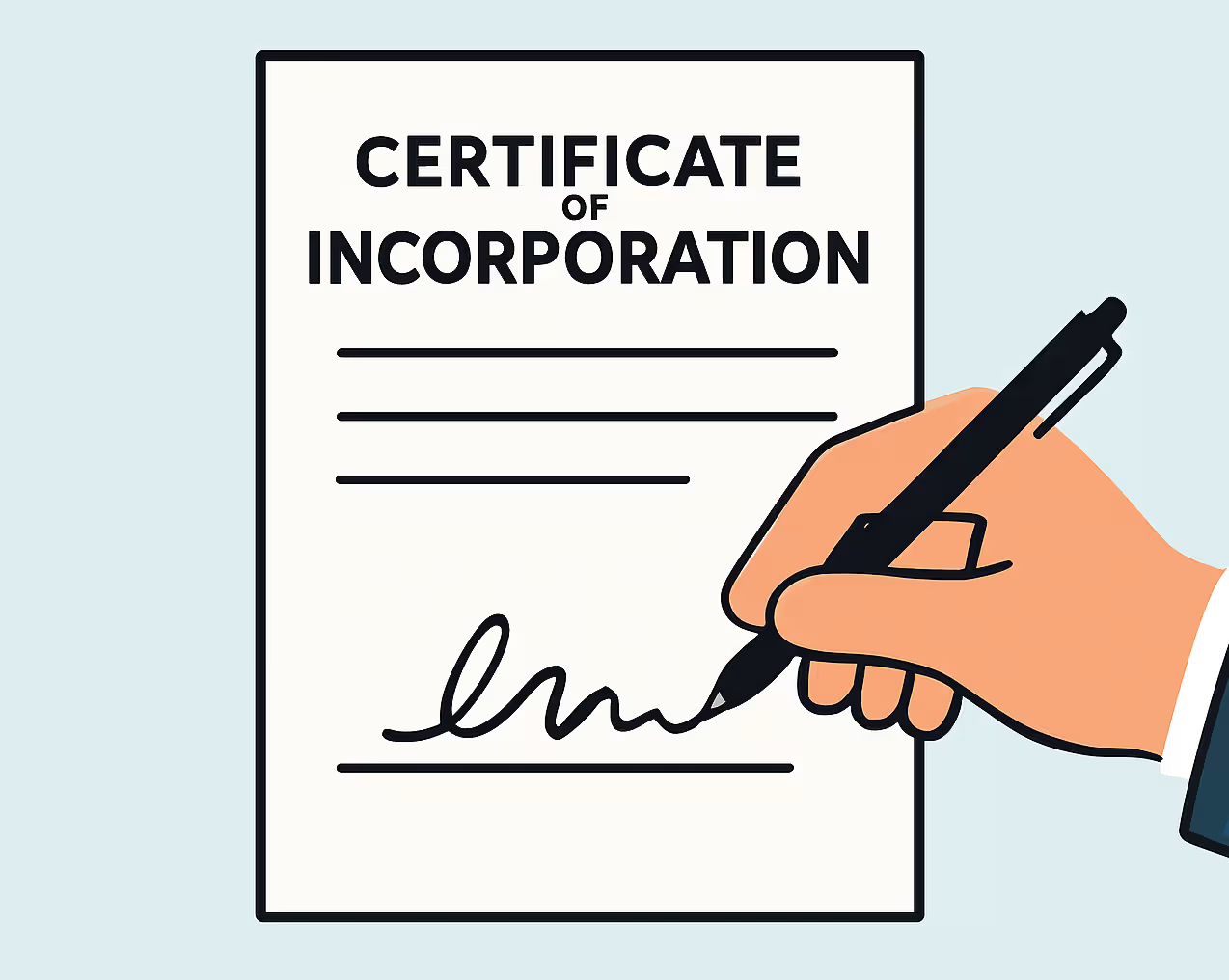
If you’re forming a Delaware corporation (or really any U.S. corporation), the incorporator is the person who signs and files the certificate of incorporation. That’s basically the job. The biggest misconception is that the incorporator is some kind of “initial owner” or shadow director. In almost every normal startup formation, the incorporator is a temporary role that exists to get the corporation born, and then vanishes the moment the initial board is appointed.
If you’re pre-seed and doing a standard startup formation, here’s what matters: the incorporator is there because a corporation can’t sign its own birth certificate, and someone has to take the first legally recognized action on its behalf. After that, the founders and board take over, and the incorporator becomes irrelevant unless you messed up the paperwork.
How the incorporator shows up in real startup and venture deals
You will not think about the incorporator on a random Tuesday in your first year.
You will think about the incorporator when you’re raising venture capital, selling the company, or in a founder dispute and someone’s lawyer starts pulling corporate records to see if your company’s early actions were valid.
In diligence, investors and acquirers are trying to answer a pretty basic question: was the company properly formed and properly authorized to issue the stock (and options) you say it issued? The incorporator is one of those early steps in the chain of legitimacy.
This is also one of those startup law topics where 99% of the time everything is fine, and 1% of the time it’s a weird, annoying cleanup project that you get to pay for at the worst possible moment.
The common assumption (and why it’s incomplete)
Here’s the assumption I hear in formation conversations:
- “We’re the founders. So we’re the incorporators, right?”
- “Does it matter who the incorporator is?”
- “If the lawyer is the incorporator, do they control anything?”
The incomplete part is that founders are mixing up roles that exist at formation:
- The incorporator (signs/filings to create the corporation)
- The initial director(s) (the first board)
- The officers (CEO/President/Secretary, etc.)
- The stockholders (the owners)
In a startup, those roles can overlap in people, but they are not the same thing. If you keep them conceptually separate, the incorporator makes sense and stops feeling spooky.
How the incorporator role actually works
A corporation doesn’t exist until the state accepts the certificate of incorporation. But the state needs a person to submit and sign that document.
That person is the incorporator.
What the incorporator usually does
In a typical startup formation (Delaware C-Corp being the most common venture setup), the incorporator:
- Signs the certificate of incorporation (or authorizes its filing).
- Files it with the state (directly or through a filing service).
- After the corporation exists, signs an “incorporator action” that:
- appoints the initial board of directors, and
- resigns as incorporator.
That’s it.
From that moment on, the corporation is governed by its board and stockholders under the charter, bylaws, and applicable law. The incorporator does not “stick around” as a decision-maker unless you intentionally keep them involved (which would be odd for a startup) or you fail to complete the handoff.
Why the incorporator disappears immediately
Because once the corporation exists, it can act through its board and officers.
The incorporator is like the person who opens the venue and turns on the lights. They are necessary before the band arrives. Once the band is on stage, the person who unlocked the door is not the one running the show.
The incorporator reality check: what people actually negotiate (basically nothing)
Nobody is negotiating the incorporator role in an incorporation.
What happens instead is that the incorporator is one of the items that shows up in a diligence checklist, and if you can’t produce the document trail, you get:
- delays,
- legal clean-up,
- investor discomfort,
- and occasionally a demand for a formal ratification of early actions.
Investors don’t want to spend time on formation hygiene. They want to spend time on valuation, product, traction, and terms. If your paperwork pulls them into corporate archaeology, it’s not a great signal—even if the underlying business is strong.
Concrete examples of how this becomes a problem (rare, but real)
Example 1: The incorporator never resigned, and nobody appointed an initial board
This happens in DIY formations: someone files the certificate, but nobody signs an incorporator action or appoints the initial directors properly.
Then the “board consents” you’ve been signing for a year are technically signed by people who may not have been properly appointed as directors.
Does that mean everything is automatically invalid? Not necessarily. But it’s a mess you’ll fix later with ratifications—meaning time, money, and distraction.
Example 2: The company can’t find its early corporate records
Even with counsel, startups misplace formation binders, lose signed consents, or never got signatures in the first place.
When diligence hits, you need to reconstruct:
- the incorporator action,
- initial bylaws adoption,
- initial stock issuances,
- option plan adoption,
- and other foundational approvals.
Again: solvable, but annoying, and it always costs more under a deadline.
Example 3: Founder dispute where someone challenges early authority
In a founder breakup, people look for leverage. If governance was sloppy early, one side may argue that certain actions (like officer appointments, equity issuances, or repurchases) weren’t properly authorized.
Even if the argument is ultimately fixable, it changes negotiating dynamics because uncertainty is a bargaining chip.
This is why “boring startup law” exists: not because it’s fun, but because it reduces the surface area for disputes.
An incorporator analogy (video games edition)
The incorporator is like the person who clicks “Create New Game” and picks the starting settings.
They’re required to start the run. But once the game loads, that person isn’t the party leader unless the game explicitly says so. The real control shifts to the characters and the rules of the world (board, officers, stockholders, charter, bylaws).
If you never finish setup and hand off control, you’re basically playing a run with corrupted save data. It might still work, but you don’t want to discover that during a boss fight (venture financing or an acquisition).
Theory vs. reality
Theory: The incorporator is an important corporate role.
Reality: It’s a procedural role with almost no ongoing significance in a normal startup.
Theory: It doesn’t matter if you skip the incorporator action because “we all agree anyway.”
Reality: It matters when someone outside your friend group needs proof—investors, acquirers, banks, or a court.
Theory: You can always clean it up later.
Reality: You can, but you’ll pay more, and you’ll do it when you’re busy.
The practical takeaway
If you’re forming a company, treat the incorporator as a checkbox with one real purpose: create a clean handoff to a properly appointed initial board. After that, forget it exists.
What you should do differently (especially if you formed DIY):
- Make sure you have a signed incorporator action appointing the initial director(s).
- Make sure the initial board adopted bylaws and approved the initial stock issuances.
- Keep those records somewhere you can actually find them when diligence arrives.
This isn’t startup hype. It’s startup law hygiene. And it’s a cheap way to avoid expensive distractions later.
Quick FAQ
Can a founder be the incorporator?
Yes. Totally normal in DIY formations. It doesn’t give the founder special control beyond the initial formation steps.
Can my startup lawyer be the incorporator?
Yes, and that’s common. It’s administrative convenience, not a power grab.
What if we never did an incorporator action?
Talk to counsel and clean it up sooner rather than later. It’s usually fixable with a short set of ratifications, but it’s easier before you’re in a financing or M&A timeline.