Last Updated on April 29, 2026 by Ryan Roberts
Par value is one of those startup law concepts that feels like it should matter a lot—until you see how it actually shows up in real venture deals.
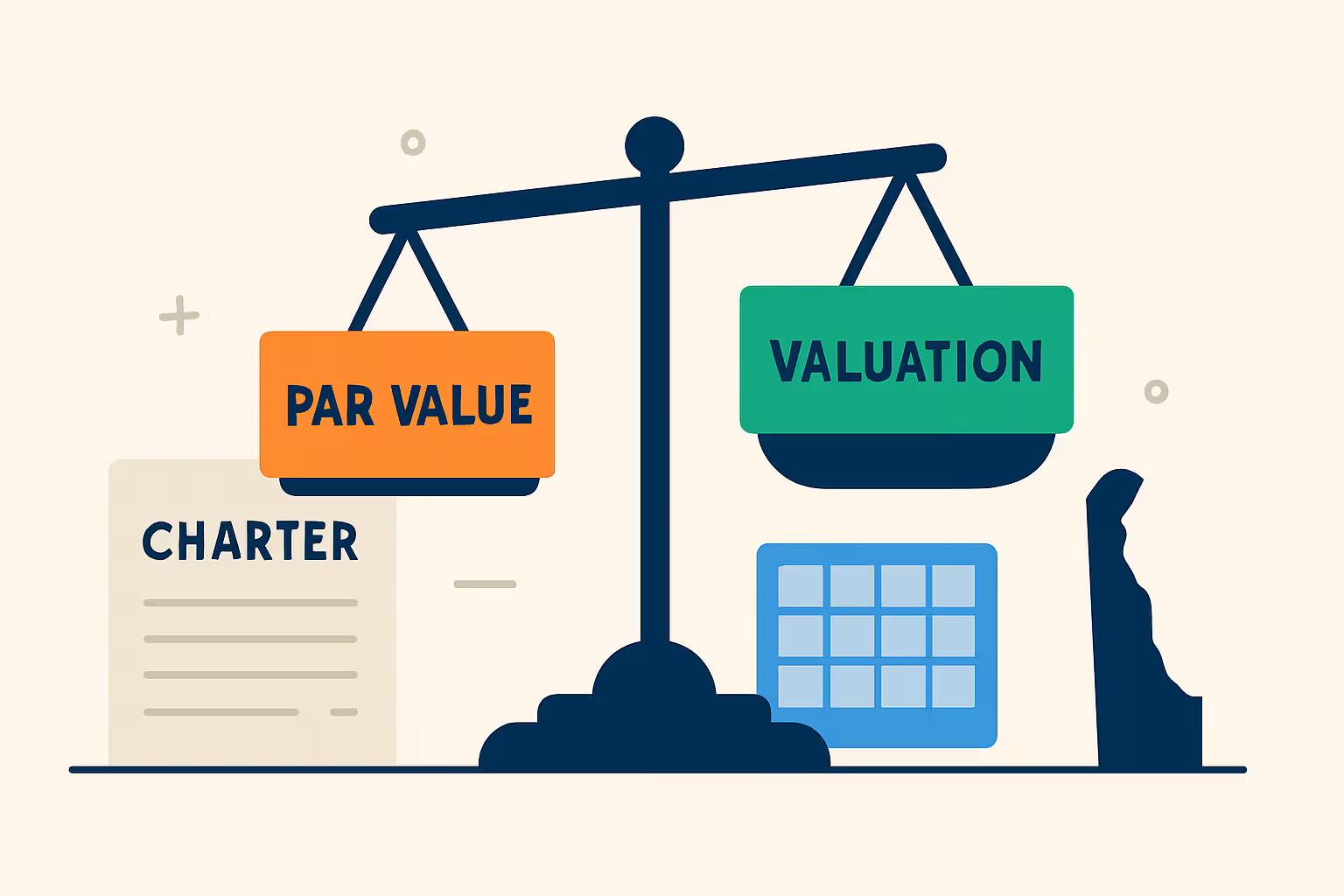
Here’s the short answer: par value is a legal minimum price for stock, not a valuation, and for most early‑stage startups, it’s a formality you set low and move on from.
This applies to you if you’re forming a Delaware C‑corp, issuing founder stock, or getting ready for your first venture financing. The biggest misconception is that par value affects how investors price your company or how much your shares are “worth.” It doesn’t.
What it does affect is paperwork, accounting entries, and—if you get it wrong—avoidable friction later. Let’s walk through how this actually works in practice.
What par value actually is (and what it isn’t)
Par value is the minimum legal price per share that your corporation can issue stock for under state corporate law. In Delaware, that number is set in your certificate of incorporation.
That’s it.
Par value is not:
- A valuation of your company
- What investors think your stock is worth
- What the IRS uses to judge fair market value
- A proxy for how “serious” your startup is
Think of par value like the face value printed on an old paper stock certificate. It exists because corporate statutes require it, not because modern venture markets rely on it for economic meaning.
In real startup law practice, par value is closer to a compliance checkbox than a negotiating point.
The common founder assumption (and why it’s incomplete)
Founders often assume that setting a very low par value—like $0.00001 per share—somehow protects them, or that setting a higher one signals confidence.
Neither is really true.
Setting a low par value doesn’t lower your valuation, and setting a higher one doesn’t impress investors. Venture capital pricing is driven by negotiated price per share in a financing round, not by par value buried in your charter.
Where par value does show up is in:
- How much cash founders technically have to pay for their shares
- How your balance sheet records “common stock” versus “additional paid‑in capital”
- Whether your corporate documents are internally consistent
Those are real considerations—but they’re operational, not strategic.
What most startups actually set (market norms)
In U.S. venture‑backed startups, especially Delaware C‑corps, par value is almost always set very low.
Common market norms:
- $0.00001 per share
- $0.0001 per share
- Occasionally $0.001 per share
Once you get above that range, you’re no longer “wrong,” but you are making life slightly harder for no real upside.
Why? Because founders usually buy millions of shares. A higher par value means founders technically need to write a bigger check at formation. That money isn’t economically meaningful—but it’s still real cash.
In practice, investors don’t care which number you picked, as long as it’s sensible and consistent.
One place par value can matter: Delaware franchise taxes
There’s one important caveat to all of this, and it has nothing to do with valuation or investor perception. It has to do with Delaware franchise taxes.
Delaware calculates franchise tax using two alternative methods: one based largely on authorized shares, and another based on assumed par value capital. You’re required to pay whichever method produces the lower tax—but your par value choice affects which method applies and how expensive the result can be.
Two common traps I see in practice:
No‑par value stock.
If your charter authorizes stock with no par value, Delaware generally forces you into the authorized shares method. If you’ve authorized millions of shares (which most startups do), that method can produce a surprisingly large tax bill—even when the company is early‑stage and revenue‑light.
Unnecessarily high par value.
At the other extreme, setting a high par value can inflate the company’s assumed par value capital, particularly once you have real assets on the balance sheet. That can also drive franchise taxes higher than founders expect.
This is why most venture‑backed startups land in the boring middle: a very low, non‑zero par value. It keeps flexibility, avoids edge cases in the tax formulas, and minimizes the risk of an avoidable annual surprise from Delaware.
This isn’t about clever tax planning. It’s about not creating a self‑inflicted compliance problem that shows up years later, when fixing it requires a charter amendment and extra fees.
What founders usually worry about too much
Founders sometimes fixate on par value because it feels like an early lever they control.
In reality, it’s one of the least important economic choices you’ll make.
What matters far more:
- How much equity you authorize
- How you structure vesting and option pools
- How you price your first venture financing
- How your charter handles control and liquidation
Par value doesn’t meaningfully affect any of those.
The practical takeaway
If you remember one thing, remember this:
Set par value low, keep it standard, and don’t overthink it.
For most startups, that means:
- Choose a low, non‑zero par value
- Make sure founder stock is properly issued and paid for
- Sanity‑check par value and authorized shares together to avoid franchise‑tax surprises
- Move on to decisions that actually affect ownership and outcomes
Par value is startup law housekeeping. Necessary—but not strategic.
Quick FAQs founders actually ask
Does par value affect my 409A valuation or taxes?
It doesn’t affect your 409A valuation—those are based on fair market value, not par value. But it can affect Delaware franchise taxes, especially if you use no‑par stock or set par value unnecessarily high.
Can investors force us to change par value later?
In practice, no. It’s not a negotiating point in venture financings.
Will a buyer care about par value in an acquisition?
Only to confirm your stock was validly issued. Clean paperwork matters more than the number itself.