Last Updated on April 29, 2026 by Ryan Roberts
Multiple classes of common stock are one of those startup law topics that tend to surface when founders start thinking seriously about control. You hear about Class A and Class B structures from public companies, late‑stage startups, or advisors who’ve seen them used well…and sometimes poorly.
Used thoughtfully, multiple classes of common stock can solve real problems. Used reflexively, they can add complexity without much payoff.
This article explains what these structures actually are, why founders consider them, how investors tend to view them, and when they meaningfully affect outcomes. The goal is not to discourage their use, but to put them in proper context so founders can decide when they help, or when simpler approaches work just as well.
What “Multiple Classes of Common Stock” Actually Means
Common stock is the equity founders and employees usually hold. It typically carries voting rights, participates in upside if the company succeeds, and sits behind preferred stock in a liquidation.
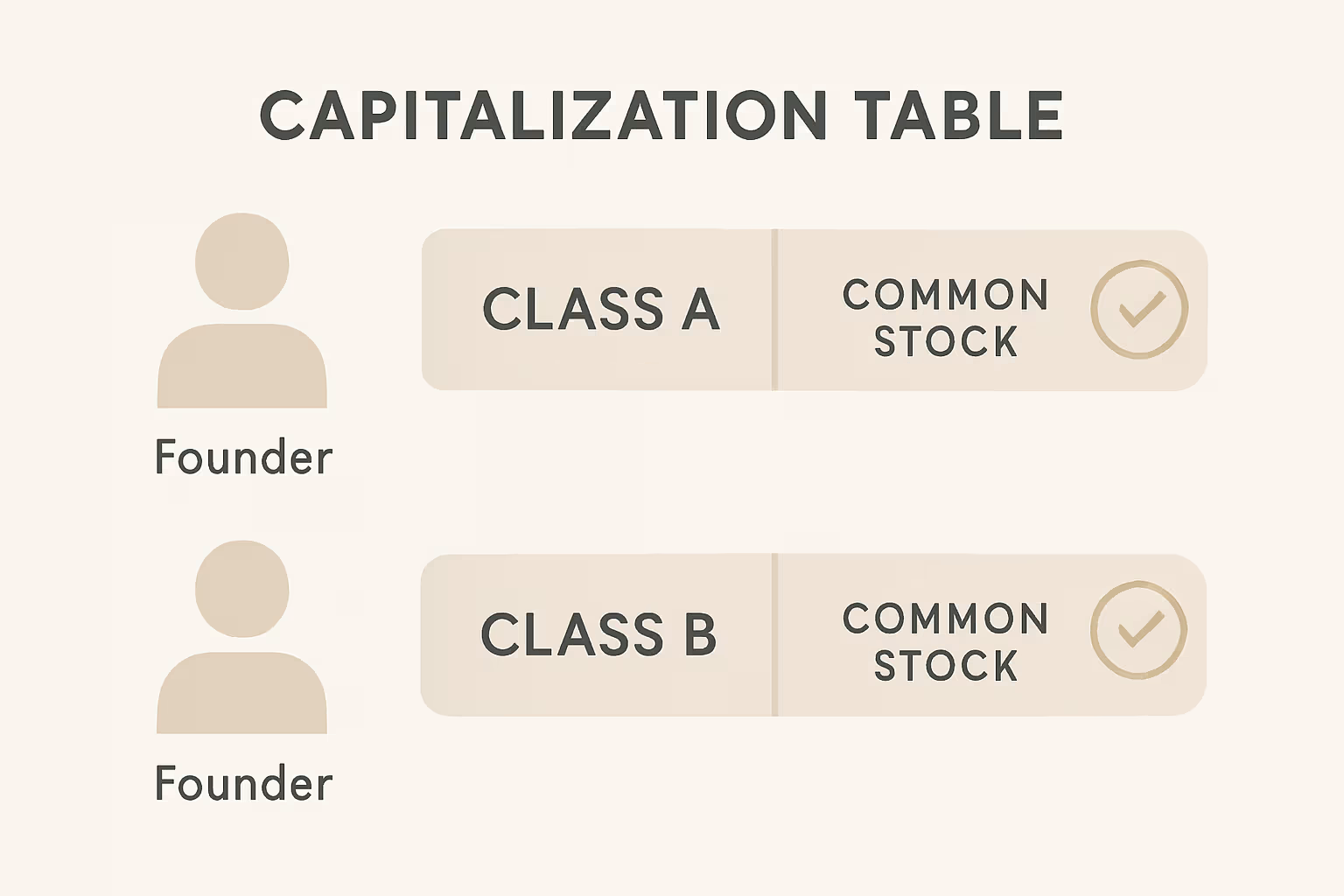
A multiple‑class common stock structure means the company has more than one type of common stock with different rights. In practice, this almost always appears as Class A Common Stock, Class B Common Stock, and occasionally additional classes.
The labels themselves are not important. What matters are the rights attached to each class.
A typical early‑stage setup looks like this:
- Class A Common Stock –> Often held by founders and may carry multiple votes per share.
- Class B Common Stock –> Commonly issued to employees, advisors, or later common holders, usually with one vote per share.
Economically, these classes are usually identical. If the company sells and there is value left after preferred stock, Class A and Class B participate pro rata. The distinction is almost always about voting and governance, not economics.
Why Founders Use Multiple Classes of Common Stock
Founders usually consider this structure for one of three reasons.
Preserving Voting Control
As companies raise capital and issue equity, founders naturally worry about dilution—not just of ownership, but of voting power.
A high‑vote class of common stock can allow founders to retain voting control even as their economic ownership declines. For companies where founder vision and continuity matter, this can be a legitimate goal.
Addressing Founder Asymmetry
Not all founders contribute in the same way or stay equally involved over time. Multiple classes of common stock can separate economics from governance when founders have different roles, timelines, or commitments.
This can be cleaner than side agreements, provided the structure is transparent and well‑documented.
Creating Governance Stability
In some businesses—particularly those with long product cycles, regulatory exposure, or mission‑driven goals—founders may want governance stability that extends beyond early financings.
In those cases, multiple classes can be part of a broader governance design rather than a defensive move.
How Investors Usually Think About It
Most venture investors are not philosophically opposed to multiple classes of common stock. But they are pragmatic.
Investors already negotiate for control through preferred stock terms: board composition, protective provisions, consent rights, and vetoes over major actions. Those mechanisms are familiar and well‑understood.
When investors see Class A and Class B common stock, their focus is usually less on the class names and more on a few practical questions:
- Who controls the board?
- When, if ever, does high‑vote common convert?
- Does this structure affect exit decisions?
If the answers are clear and reasonable, investors often accept the structure, especially if the company has leverage. If the answers are vague or absolute, resistance increases.
Control in Theory vs. Control in Practice
This is where expectations need calibration.
A helpful way to think about this is the difference between owning the steering wheel and owning the fuel gauge. Voting control can determine who turns the wheel day to day. Economics determine how far the company can actually go—and when it needs to stop.
In venture‑backed companies, economic realities tend to assert themselves earlier than founders expect. Board composition, preferred stock rights, and capital needs usually drive outcomes long before common‑stock voting mechanics do.
That doesn’t make Class A / Class B structures irrelevant. It just means their influence is real but bounded.
Common Structural Features
While details vary, most multiple‑class common structures share a few features.
High‑Vote Founder Common
One class (typically Class A) carries multiple votes per share and is held by founders. Class B carries one vote per share and is issued more broadly.
This structure is well‑known from public companies but is less common (and often more constrained) in early‑stage startups.
Conversion Mechanics
High‑vote common almost always automatically converts into single‑vote common upon certain events, such as:
- A new financing (less often)
- A founder transferring shares
- An IPO
These conversion triggers are where much of the real negotiation happens.
Sunset Provisions
Some structures automatically collapse after a period of time or once ownership drops below a threshold. Sunsets are increasingly common and often make the structure more palatable to investors.
Practical Applications: How This Gets Used
Despite the attention they get, multiple classes of common stock are used in fairly specific situations.
Early‑Stage Alignment
Some companies adopt Class A and Class B common very early to address founder alignment or formation issues. In these cases, the structure is often temporary and simplifies as the company matures.
Founder Transitions
When a founder steps back operationally but remains a significant owner, multiple classes can separate economics from governance during the transition. Clear conversion mechanics are key here.
High‑Leverage Companies
In capital‑efficient or founder‑led businesses with strong leverage, dual‑class common may persist longer. The goal is usually stability rather than entrenchment.
Internal Administration
Occasionally, companies use separate common classes for administrative reasons, such as managing voting or information rights for employees. These uses are more operational than strategic.
Across these scenarios, multiple classes tend to function as tools, not permanent power structures.
How This Gets Negotiated
Multiple classes of common stock rarely headline term sheets. They surface during diligence and charter review.
If the company has leverage, investors may accept Class A and Class B with guardrails. If not, collapsing the classes often becomes part of closing.
Investors rarely trade economics for common‑stock voting control. Founders sometimes expect this to be a major bargaining chip. In practice, it usually isn’t.
When Multiple Classes Make Sense
Multiple classes of common stock can make sense when:
- Founder leadership is central to company value
- The business requires long‑term strategic continuity
- The structure addresses a real governance problem
They work best when paired with clarity, conversion mechanics, and an understanding of how control actually shifts over time.
What Still Matters More
Even where multiple classes are used, other factors usually matter more:
- Board composition
- Protective provisions
- Founder vesting and incentives
- Financing terms and dilution
- Exit dynamics
These issues drive most outcomes, regardless of how many classes of common stock exist.
The Practical Takeaway
Multiple classes of common stock are neither a silver bullet nor a red flag. They’re a legitimate governance tool that works best when used deliberately and with realistic expectations.
If you remember one thing, make it this: use Class A and Class B common to solve specific problems, not hypothetical ones. Decide whether the structure fits your company’s leverage, stage, and goals…or whether a simpler, market‑standard approach will get you to the same place with less friction. That judgment, more than any label in the charter, is what tends to matter most in real deals.