If you’re raising a priced round (especially Series A), board composition is one of the few terms that can change your day-to-day reality as a CEO faster than your cap table does. Once you give up voting control at the board level, you may not be able to “earn it back” later without someone else’s consent.
This is mostly a founder problem (and a founder opportunity) in institutional venture financings where you’re adding investor directors and independents, not in a friends-and-family SAFE where nobody is asking for a seat. The common misconception is that “I still own most of the company, so I’m still in control.” Ownership is economic power. A board seat is governance power. They overlap, but they’re not the same thing.
Board composition just means who gets the seats and, therefore, who gets the votes. And board votes aren’t theoretical. Boards approve (or block) things like budgets, executive hires, option grants, acquisitions, raising more money, and sometimes whether you keep your job. If you’re negotiating a term sheet, board composition is where “control” becomes a number you can count.
What the board actually controls (and what it doesn’t)
In a Delaware C‑corp (the default for venture-backed startups), the board manages the business and affairs of the company. That sounds like a law school sentence because it is, but the practical version is simple: the board is the only group that can legally make many of the company’s biggest decisions, even if the stockholders “want” something else.
Yes, some actions also need stockholder approval (a merger, a charter amendment to create a new preferred series, an increase to the option pool, etc.). But in real deals the board is the first gate, and often the only gate that matters day to day: budgets, exec comp, option grants, entering into debt, signing acquisition LOIs, and approving the next financing typically start (and sometimes end) with a board vote.
Investor directors have fiduciary duties to the company and all stockholders, not just to the fund that appointed them. That doesn’t mean incentives disappear. It means the conversation is usually more subtle than “the VC is out to get you.” Most of the time, the tension shows up as differences in risk tolerance, timelines, and what each side considers a “good outcome.”
Hiring or firing the CEO (including “it’s time to bring in an adult,” said politely).
Setting the option pool size and approving major equity grants (which affects dilution and retention).
Approving a new financing, including whether you can do a bridge round and on what terms.
Approving a sale of the company, or deciding to keep going when you’d rather take chips off the table.
Approving debt, liens, and other commitments that can box you in later.
That’s why board composition shows up so early in priced round term sheets. At seed, you might not even have a functioning board beyond the founders. At Series A, the board becomes the operating system for governance, and investors start caring a lot about who can say “yes” when the company hits a wall.
Board composition norms: the board math that quietly decides who’s in charge
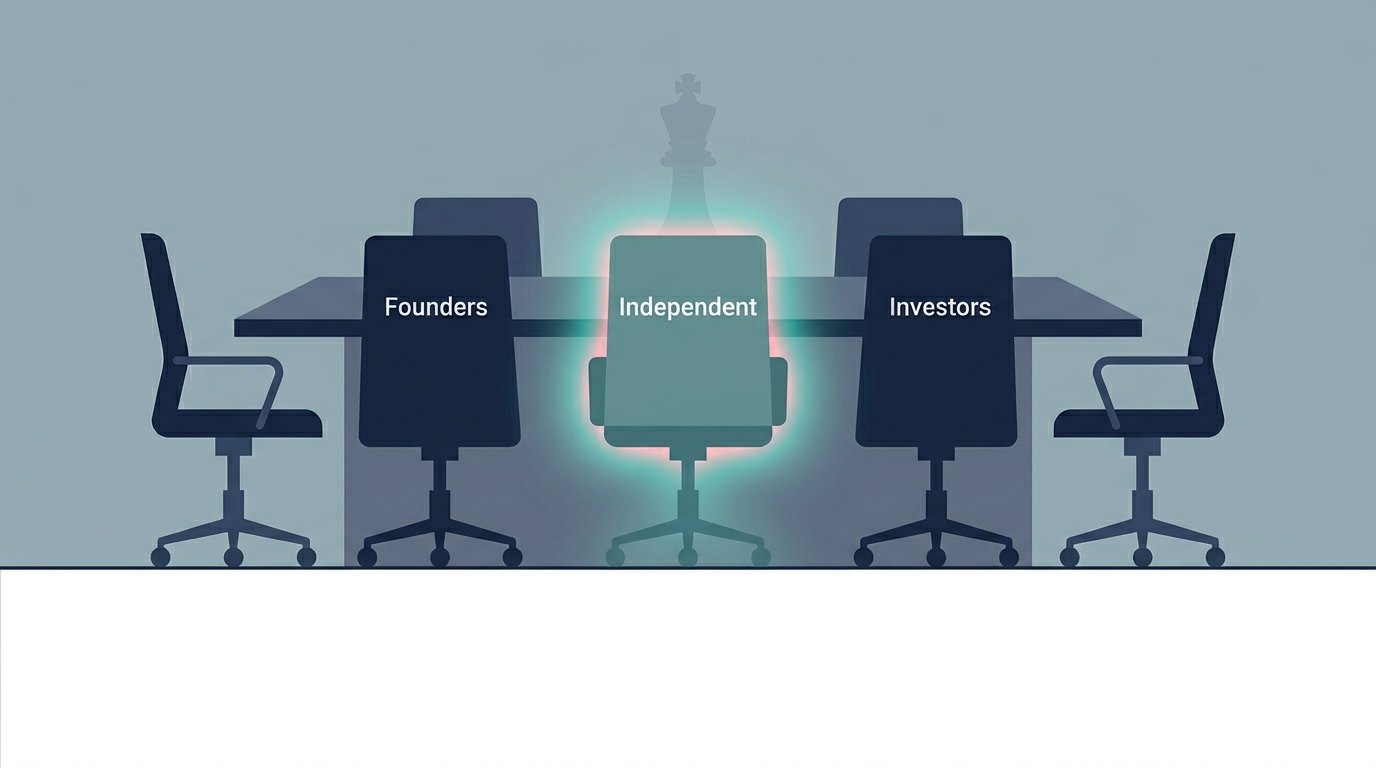
In most Series A rounds, the “normal” board composition is small (3–5 seats) and built out of three categories: founder seats, investor seats, and an independent seat. The independent is supposed to be neutral. In practice, the independent is “neutral” the way a Supreme Court justice is neutral: the identity matters a lot.
Here are common patterns and what they usually mean for control. I’m going to be blunt: the numbers matter more than the vibes.
3‑person board (seed-ish): Often 2 founders + 1 investor. You have formal control as a founder, but you’ve added an outside voice who can slow you down (sometimes in a good way).
5‑person board (classic Series A): Often 2 founders + 2 investors + 1 independent. This is the “balanced” structure everyone claims to like because nobody has a majority on paper.
Founder‑majority 5‑person board: 3 founders + 1 investor + 1 independent is less common in an institutional Series A unless you have real leverage (hot deal, oversubscribed round, or investors who are unusually founder-control tolerant).
Investor‑leaning 5‑person board: 1 founder + 2 investors + 2 independents (or 2 investors + 1 founder + 2 independents where the independents are effectively investor-selected). This can happen when you’re doing a rescue round or the company has already stumbled.
The independent seat is where control shifts hide. A term sheet that says “one independent director mutually agreed” is very different from “one independent director approved by the investors” (or “mutually agreed” where you’re under time pressure and the lead investor has a short list). If the board is 2–2–1, the swing vote is the independent. So the real question isn’t “do we have an independent?” It’s “who effectively picks the independent?”
Example: you have a 5‑person board (2 founders, 2 investors, 1 independent). You want to extend runway by cutting burn; one investor director thinks you should swing for growth and raise again; the other wants to explore a sale. If the independent aligns with the investors, you can find yourself taking a path you didn’t choose even though you’re still the CEO and you might still own a lot of common stock.
If you want a sports analogy: think about a soccer match where possession stats look great, but the other team controls the midfield. You can “own” the ball for long stretches and still not control the game. In venture governance, the independent seat is often the midfield.
How founders accidentally give up control (and why it’s hard to get back)
Board control is sticky because governance terms compound. Once you create a structure where investors (or investor-aligned independents) can outvote founders, future rounds tend to build on that structure, not reset it. Investors don’t like reopening governance without a reason. And “I didn’t realize what I signed” is not the kind of reason that gets traction in a term sheet negotiation.
In practice, founders lose board control through a few repeatable mechanics:
Board expansion that sounds harmless. “Let’s go from 3 to 5 seats.” Okay, but who appoints the two new seats, and do you get one of them?
Vacancy and replacement rules. If an investor director resigns, does the investor get to name the replacement automatically? If an independent resigns, is it still “mutual consent,” or can one side install someone quickly?
Director removal rules. Removing a director is often controlled by the class or group that elected that director (e.g., the preferred elects the preferred director). If you don’t elect them, you usually can’t remove them.
“Independent” directors who aren’t actually independent in negotiation dynamics. Even when the documents say “independent,” selection dynamics and personal incentives can tilt the seat.
One thing founders often over-optimize is whether an investor gets a board observer instead of a voting seat. Observers can change the room dynamics, but they don’t vote. If you’re trading a voting seat for an observer seat, that can be meaningful. If you’re fighting about an observer seat while giving away the swing independent selection, you’re focusing on the decoy.
Let’s make it concrete with a few common scenarios I see in venture deals.
Example 1: The “helpful” exec hire becomes a CEO conversation. You miss a quarter, or the market shifts, and the board wants to hire a CRO or COO. You’re open to it. Then the conversation drifts to whether you’re the right person to run a larger organization. If investors and the independent have three votes, you don’t get to “win” that debate by persuasion alone. The documents don’t say “fire the founder,” but the voting math can make it possible.
Example 2: Bridge round vs. priced round, who gets to choose the pain? You need money. Option A is a quick bridge note/SAFE from insiders. Option B is a priced round with a lower valuation and heavier terms. Many founders assume this is mainly an economics question. It’s also a governance question, because the board typically has to approve the financing path, and preferred stockholders often have separate consent rights. If your board is investor-leaning, you may find the company pushed toward the option that better protects the fund’s downside, even if it’s rougher on common.
Example 3: A real acquisition offer shows up, and you don’t control the answer. An acquirer offers a price that feels life-changing to you but doesn’t hit a fund’s return model. If investors and the independent can block the deal at the board level (or through class votes), the company can keep going even if you’d rather sell. And in diligence, acquirers look at the governance stack because they want to know who must approve the deal, how clean the process is, and whether any director conflicts need special handling.
How board composition changes by stage (and when you actually have leverage)
Board composition becomes “real” at Series A because that’s when you typically add your first true institutional lead, start building a board cadence, and begin making decisions that can’t be reversed cheaply. In a healthy Series A, the market norm is some version of a balanced board (often 2 founders, 2 investors, 1 independent) with the independent selected by mutual consent.
At seed, it’s common to keep a 3‑person board, sometimes with only founders initially and an investor seat added later when a lead appears. If you’re raising on SAFEs and you don’t have a priced round lead, pressure for formal governance is usually lower. That’s why a lot of early founders don’t build the “board composition muscle” until the Series A term sheet hits their inbox.
Later-stage rounds can add complexity: more investor seats, more independents, and sometimes committees (audit/comp) that matter more than founders expect. Also, if the company is wobbling, governance terms tend to move “investor-protective” fast. In a down round or rescue financing, founders are often negotiating from a hole, and the board terms reflect that.
If you have leverage, here’s what is often achievable (and what’s usually not):
Market norm: Balanced 5‑person board with a mutually agreed independent.
With real leverage: Delay adding the second investor seat until a later round, or keep the board at 3 seats for the first priced round (1 founder, 1 investor, 1 independent) with truly mutual selection of the independent.
Also achievable with leverage: Tighten the definition of “independent” and the process for replacing an independent so the seat can’t quietly drift to one side.
Harder than founders think: Investor takes no seat at all in a lead institutional priced round. It happens, but it’s not the default, and you’ll need a strong reason plus a very competitive process.
Theory vs. reality: “independent” doesn’t mean “harmless”
The theory is that a balanced board plus an independent director creates good governance. Sometimes it does. The reality is that independents are people, chosen through a process, with their own incentives and relationships. If your term sheet gives the lead investor practical control over the independent seat, you haven’t created balance. You’ve created a majority that can call itself “neutral.”
In real deal rooms, board composition negotiations are usually less about whether founders “deserve” control and more about two practical questions: (1) who needs comfort that the company won’t do something reckless with investor money, and (2) who needs comfort that the company won’t get sold (or forced to keep going) at the wrong time. The board is the mechanism for both.
There’s also a persistent fundraising narrative that “control terms are for amateurs; real founders optimize valuation.” That’s catchy. It’s also how you end up with a great headline valuation and a board that can outvote you on the decisions that determine whether that valuation ever means anything.
If you’re staring at a term sheet, here’s a practical checklist for the board/control pieces that actually drive outcomes:
How many seats are there, and who elects each seat? Write it out as a sentence: “Founders elect __, Preferred elects __, independent is selected by __.”
Who picks the independent, and what happens if you can’t agree? “Mutual consent” is only meaningful if there’s no unilateral fallback.
What happens when a director resigns? Replacement rights can quietly hand a seat to one side forever.
Can the board be expanded without your approval? Look for mechanics that allow adding seats by a board vote you might not control.
Do investor consent rights stack on top of board control? Protective provisions can create a second veto layer even if the board looks balanced.
Is there a board observer, and is confidentiality addressed? This is usually manageable, but it affects how candid meetings can be.
Do committees matter yet? Not always at Series A, but comp and audit committees can become real control points later.
If you remember one thing: treat board composition like a one-way door
Board composition is a one-way door more often than founders expect. Economics can be renegotiated in later rounds. Governance rarely resets unless something breaks.
What actually matters: who has the votes when you need to choose between bad options (financing path, sale vs. keep going, leadership changes) and who effectively controls the independent seat.
What usually doesn’t: whether a board meeting feels friendly, whether an observer “promises” to stay quiet, or whether you still own a big common position on the cap table.
What to do differently next time: when you review a term sheet, write the board math on a sticky note and ask one blunt question: “In a disagreement, how do I win a vote?” If the answer is “you don’t,” make sure you’re getting something in return that’s worth that trade.
Quick FAQs founders actually ask
Can investors force me out as CEO? Usually not directly by “stock vote,” but a board that can outvote you can replace the CEO or condition financing on leadership changes. If you’re negotiating a Series A, assume governance (not just performance) determines how exposed you are.
Is a 2 founders / 2 investors / 1 independent board “balanced”? It can be, but only if the independent is truly selected by mutual consent and the replacement mechanics don’t let one side capture the seat later. The swing vote is the whole point.
Should I fight hard to keep a founder-majority board composition? If you have leverage, it’s worth pushing for founder influence—especially over the independent seat and any board expansion. But if the deal is not competitive, the smarter move is often to accept a market structure and focus on the clauses that prevent quiet control drift (independent selection, replacement, and expansion rules).
Ryan RobertsStartup Lawyer
Ryan Roberts is a startup lawyer at Roberts Zimmerman PLLC with more than two decades of experience advising startups and venture capital investors. He is the author of “Acceleration” and StartupLawyer.com.